

Personal branding in Switzerland for professionals is often misunderstood. Many people believe it only matters for entrepreneurs, public figures, or those active on social media. In my work as a Senior Career Coach, I see a very different reality. Highly capable professionals often struggle to explain their value clearly, especially when their career reaches a turning point.
Over the years, I have worked with professionals across many industries. They bring strong qualifications, years of responsibility, and international experience. On paper, their CVs look solid. Yet applications stall, interviews feel flat, or the idea of consulting feels appealing, but unclear. What I hear most often is simple. “I know I have experience, but I no longer know how to explain it.”
The first instinct is usually to fix the CV. Add more details. Refine the wording. Adjust the layout. However, a CV is only a document. It lists roles, tasks, and timelines. It does not explain who you are professionally. It does not show how you create value, and it rarely builds trust in a new context.
This gap becomes especially visible in the Swiss job market. Here, clarity, credibility, and precision are expected from the very first interaction. Whether you speak with a recruiter or a potential client, competence is assumed. What makes the difference is how clearly you can position yourself.
Personal branding, in this context, is not about visibility or self-promotion. It is about professional positioning in Switzerland. It is your ability to articulate your strengths, your impact, and your professional identity in a way others can quickly understand and trust. This applies whether you are aiming for your next role or transitioning from employment to consulting.
In this article, I want to reframe how you think about personal branding in Switzerland for professionals. I will explain why your CV cannot carry this responsibility on its own. I will also show why recruiters and clients look for surprisingly similar signals. Additionally,I will share how you can start building clarity around your professional value in a structured and grounded way.
If you have ever felt that your experience is richer than the story you are currently telling, this article is for you.
Why Personal Branding in Switzerland Is Often Misunderstood
Many of the misconceptions around personal branding are not unique to Switzerland. I see them across countries and industries. What makes Switzerland different is how strongly clarity, credibility, and precision are expected. This often exposes gaps that were less visible elsewhere.
In my work, I see that the misunderstanding is not about ego. It is about language. People do not lack experience. They lack a clear way to express it.
Why experienced professionals struggle to explain their value
Most professionals build their careers by delivering results, not by talking about themselves. They solve problems, manage teams, and take responsibility. Over time, this becomes normal to them.
The challenge appears when they need to explain their value outside their current role. What once felt obvious now feels hard to put into words. I often hear professionals say they have done a lot, but they do not know what to highlight anymore.
This is especially common during executive career transitions in Switzerland and is even more noticeable for expats. Cultural expectations differ, and what once signaled value in another market does not always translate well in the Swiss job market.
This is where personal branding for professionals in Switzerland becomes essential, not as promotion, but as clarity.
The hidden cost of relying only on a CV
A CV is an essential tool. However, using it as your only personal branding asset creates clear limitations.
First, a CV is reactive by design.
You use it when an opportunity already exists. It does not help you be visible before a role is open or before a client starts looking. In the Swiss job market, many opportunities appear through networks and early conversations. A CV alone does not support this.
Second, a CV cannot show how you create value beyond a role.
It summarizes responsibilities and results. It does not explain your thinking, or your approach. This becomes a barrier for professional positioning in Switzerland, especially for senior roles and consulting work.
Third, a CV does not support career evolution.
It works best for linear paths. When you reposition yourself, change scope, or move toward consulting, the CV lacks the space to explain intent and direction. This makes transitioning from employment to consulting harder than it needs to be.
A CV remains the foundation. Personal branding provides the signal that connects your experience to future opportunities.
Related: How to Create a Swiss CV (Lebenslauf) That Actually Gets You Interviews
Your CV Is a Document. Your Personal Brand Is a Signal.
In Switzerland, professionals are expected to have a strong CV. This is not optional. A well-written CV should clearly show relevance, progression, and credibility.
The challenge begins when we expect the CV to do more than it was designed to do.
What a CV can and cannot communicate
A CV is a structured document. It communicates facts, roles, dates, responsibilities, and scope. When done well, it shows why your past experience fits a specific role.
What it cannot fully communicate is context. It cannot easily show how you think, how you lead, or how you create impact beyond your job title. It also struggles to convey your professional identity when your career is evolving.
This is where many experienced professionals feel stuck. Their CV is strong, yet the response is lukewarm. Not because the experience is weak, but because the signal is incomplete.
A CV is also a reactive tool. You send it in response to an opening. In the Swiss job market, many opportunities are filled through networks, referrals, or early conversations. Without a clear personal brand, you remain invisible in these spaces.
This limitation becomes even more visible for personal branding for consultants in Switzerland and for professionals transitioning from employment to consulting. Clients are not only reviewing experience.
They are assessing trust, clarity, and positioning.
Why clarity matters more than completeness
Many professionals believe the solution is to add more. More details. More bullet points. More explanations. In reality, this often creates the opposite effect.
Clarity is not about saying everything. It is about saying the right things. Recruiters and clients do not want a full inventory of your career. They want to quickly understand where you fit and how you add value.
In Switzerland, precision matters. Clear positioning signals confidence and credibility. It shows that you understand your strengths and your market.
This is why personal branding in Switzerland for professionals focuses on clarity rather than completeness. When your message is clear, your CV becomes easier to read. Conversations become more focused. And opportunities become easier to access.
Your CV supports the message. Your personal brand carries it.
Why Personal Branding Matters More Than Ever in the Swiss Job Market
The Swiss job market has always been selective. Today, it is getting more and more crowded, international, and highly informed. While strong qualifications are common, clear positioning is not.
Personal branding in Switzerland for professionals has become essential because expectations have shifted. Not toward louder profiles, but toward clearer ones.
What recruiters and decision makers expect in Switzerland
Recruiters and hiring managers in Switzerland expect a solid baseline. Education, experience, and stability are assumed to be in place. A strong CV is the starting point, not the differentiator.
What they look for next is coherence. They want to understand how your experience fits together and how it translates into value for their organization. This applies across roles, industries, and seniority levels.
Decision makers also value precision. Vague profiles create hesitation. Clear profiles create confidence. When your positioning is easy to understand, it becomes easier to advocate for you internally.
This is why career coaching in Switzerland increasingly focuses on professional positioning, not just applications. The clearer your signal, the easier it is for others to support your move.
Why competence is assumed, and clarity makes the difference
In the Swiss job market, most professionals applying for roles are qualified. Many are even overqualified.
The real question is fit. Where do you belong? What problem do you solve? And why you, rather than someone with a similar background?
This is where personal branding makes the difference. It connects your experience to a specific value proposition. It helps others quickly understand your relevance without having to interpret it themselves.
For job seekers, this reduces friction in interviews. For consultants, it strengthens trust before the first conversation. For executives in transition, it provides structure during change.
This is not about saying more. It is about saying the right things, clearly and consistently.
In Switzerland, clarity is not a bonus. It is a requirement.
The Real Challenge. Undervaluing Your Own Experience

One of the biggest obstacles I see in career coaching in Switzerland is not lack of skill or ambition. It is how professionals perceive their own experience.
Why professionals undervalue their strengths
Professionals build value gradually. Responsibilities increase over time. Decisions become more complex. Scope expands. Because this happens step by step, the growth often goes unnoticed.
What once required effort, becomes routine. What was once a stretch, becomes standard. As a result, professionals stop seeing their strengths as differentiators. They see them as part of the job.
This is especially common in stable environments, such as Switzerland, where careers reward consistency, reliability, and long-term contributions. The better someone performs, the more their strengths are absorbed into daily expectations.
I often see this with professionals who manage complexity quietly. They coordinate across functions, reduce risk, and make systems work. Because the impact is indirect, it feels less visible. Yet this is exactly the type of value Swiss organizations rely on.
The gap between internal experience and external perception
Internally, professionals carry a deep understanding of their work. They know the context, the trade-offs, and the constraints they manage every day. Externally, this insight is rarely visible.
This creates a gap. Others only see the job title and a short description. They do not see the judgment calls, the influence without authority, or the accumulated expertise behind the role.
This gap becomes critical during career transitions. In executive career transition in Switzerland, professionals often assume their reputation will speak for itself. Unfortunately, it does not travel automatically to a new context.
The same applies to personal branding for consultants in Switzerland. Clients do not buy experience in the abstract. They buy clarity. They want to understand how your past decisions translate into value for their specific situation.
Personal branding helps close this gap. Not by exaggerating experience, but by translating it. It makes implicit value explicit. It gives others access to what you already know.
Employment and Entrepreneurship Require the Same Foundation
Many professionals treat employment and entrepreneurship as opposite paths. One feels structured, the other feels independent. As a result, they believe they need different profiles, different stories, and different identities.
In practice, the foundation is the same.
What employers and clients look for is remarkably similar
Employers and clients ask different questions, but they evaluate in similar ways. Both want clarity. They want to understand what you do, where you create value, and in which situations your experience is most relevant.
Both assess credibility early. Titles, qualifications, and years of experience matter, but they are not decisive. What matters is whether your experience clearly addresses the role requirements or the problem that needs to be solved.
Both also think in terms of risk. In Switzerland, decisions are cautious and well-justified. Employers and clients want to feel confident explaining why they chose you. Clear professional positioning helps them do that.
This is why personal branding in Switzerland for professionals applies equally to employment and to freelance or self-employed work. The signal you send must be easy to interpret in both contexts.
One professional identity. Multiple career paths.
Your professional identity should not change depending on how you work. Whether you are employed, self-employed, or combining both, the core of who you are professionally remains stable.
What changes is the format, not the substance. The same experience can support a permanent role, freelance work, or entrepreneurship when it is articulated clearly.
I see many professionals overcomplicate this step. They believe entrepreneurship requires reinvention. In reality, most need translation, not transformation.
Personal branding provides that continuity. It allows you to move between employment and entrepreneurship without losing coherence or credibility.
One identity. Multiple paths. Clear positioning.
What Personal Branding Actually Means for Professionals
For many professionals, the term personal branding feels uncomfortable. It is often associated with visibility, self-promotion, or online presence. This misunderstanding creates resistance.
In reality, personal branding for professionals is about positioning, not promotion.
Personal branding is about positioning, not promotion
Positioning answers a simple question: how should others understand your unique professional value? It is not about being louder. It is about being clearer.
For professionals, personal branding means defining the role you want to play in the market. It clarifies where your experience fits and where it does not. This clarity helps employers, recruiters, and clients quickly place you.
In the Swiss job market, this is critical. Decision makers value precision. They want to know how you contribute, not how you market yourself.
This applies equally to employment, freelance work, and entrepreneurship. Whether you are a job seeker, an executive in transition, or self employed, positioning helps others understand when and why to involve you.
How to communicate impact without self-promotion
Many professionals hesitate to talk about impact because it feels like self promotion. This usually comes from focusing on personal traits rather than outcomes.
Impact is not about adjectives. It is about context and results.
Instead of describing yourself as strategic or reliable, you represent the situations you handled and the results that followed. You explain what changed because you were there.
For example, explain how you stabilized a team, reduced risk, improved a process, or supported a transition. These statements are factual. They do not rely on opinion.
This approach is especially important for personal branding for job seekers in Switzerland and for professionals positioning themselves as consultants or freelancers. Employers and clients want evidence they can trust.
Personal branding, when done well, removes exaggeration. It replaces vague claims with clear signals. It allows you to communicate impact in a way that feels accurate, professional, and credible.
Introducing Power Cards as a Clarity Tool

Before professionals can communicate their value clearly, they need to understand it clearly themselves. This is often the missing step.
Experience creates this clarity over time. Each role, decision, and challenge refines how professionals see themselves. Reflection is what turns that lived experience into conscious understanding.
Why structure helps professionals communicate value
Many professionals rely on intuition when describing themselves. They speak from habit, not from awareness. This is not a lack of intelligence. It is a lack of structure.
Research on self awareness suggests that most people overestimate how well they understand themselves. According to research summarized by the University of Arkansas Division of Agriculture (2022), only around 10 to 15 percent of people demonstrate a high level of true self awareness. Most overestimate how well they understand their own patterns, strengths, and drivers.
Without structure, reflection stays shallow. Important insights remain implicit. Language becomes vague. This makes it hard to explain value in a precise and consistent way.
Structure changes this. It slows thinking down. It forces attention on specific questions. Instead of reacting, professionals observe.
This process creates distance from assumptions and routines. Over time, it reveals what actually matters in how someone works and decides.
How Power Cards support clear professional positioning
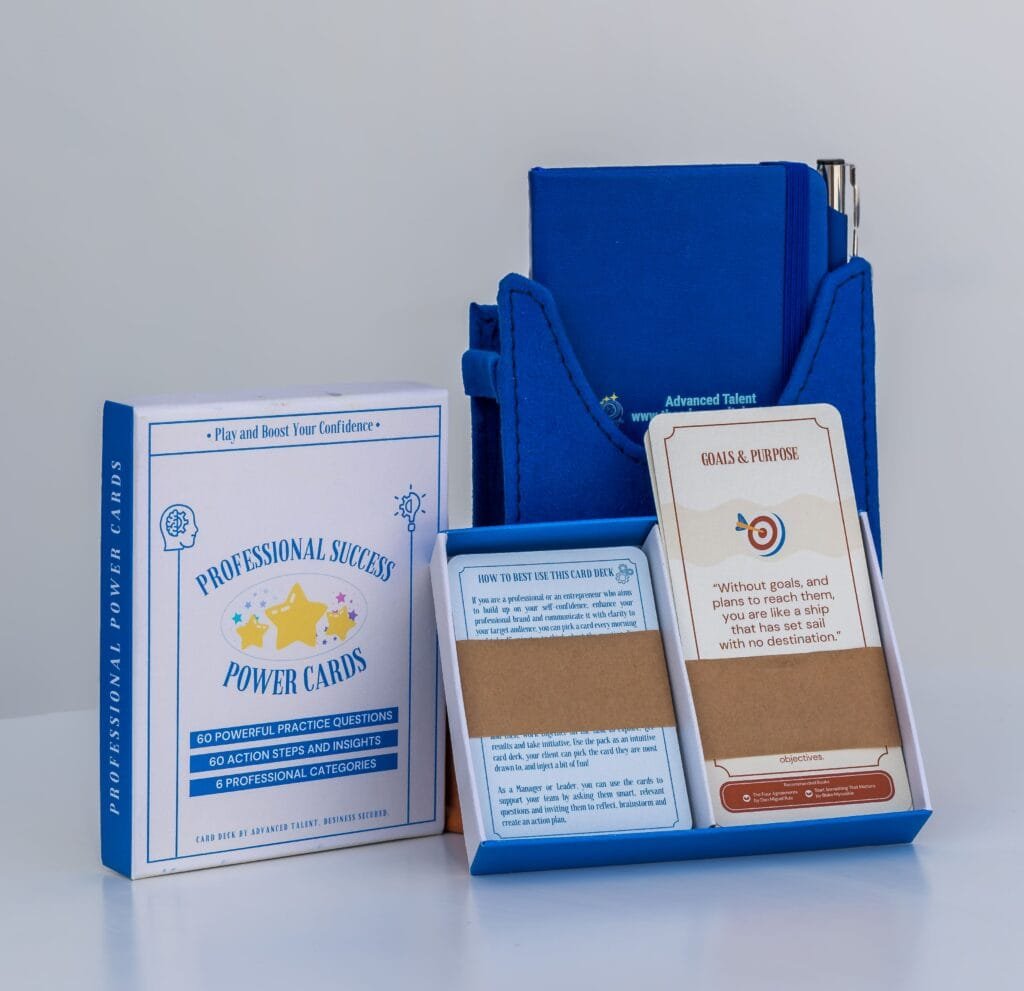
This is the reason why I created the Professional Success Power Cards.
The Power Cards are a structured self-coaching tool designed to guide reflection through focused, relevant questions. Each card targets a specific aspect of professional identity: Values and Strengths, Self-confidence, Goals and Purpose, Teamwork and Communication, Areas of Improvement, Accomplishments and Recognition.
The questions are drawn from thousands of hours of coaching work with professionals, leaders, and entrepreneurs. Each one is designed to help you recognize meaning, patterns, and purpose.
In addition to the questions, every card includes practical action steps and insights, two carefully selected book recommendations, and a motivational quote aligned with the question and its category.
As a coach in a pocket, the cards help professionals identify what drives their performance and where their real value lies. This clarity forms the foundation of professional positioning.
PROFESSIONAL SUCCESS POWER CARDS: “I think the design of the cards is clear and concise. The use of color and layout is effective in making the cards visually appealing and easy to read. The cards are also well-organized, and the information is presented in a clear and concise manner. I am not aware of any other product similar to this.
I can imagine that the cards could be a useful tool for people who are looking to improve their professional success. The cards could help people to identify their strengths and weaknesses, set goals, and develop strategies for achieving their goals.
Peter Anagnostou | Executive Coach | Founder
At this stage, nothing is communicated outward yet. The work happens internally. The goal is not expression, but understanding.
Once this foundation is in place, translating experience into clear messages becomes significantly easier.
Using Power Cards for Employment and Entrepreneurship
The value of self-awareness only matters if it translates into clearer conversations. This is where the Power Cards become practical.
They help professionals move from internal reflection to external communication.
How Power Cards support job search conversations
Job search conversations often fail at the same point. Professionals describe roles and tasks, but struggle to explain impact and direction.
Power Cards help structure this thinking before the conversation happens.
By working regularly with the cards, professionals clarify what they are good at, what motivates them, and where they create the most value. This makes answers more precise and less rehearsed.
Instead of searching for the right words in the moment, professionals already know how to explain their decisions, strengths, and results. Interviews become clearer. Networking conversations feel more natural.
This is especially useful in the Swiss job market, where recruiters expect concise and well-structured answers. Clarity signals preparation and credibility.
The Power Cards also help professionals prepare for career transitions. When roles change or direction shifts, the questions guide reflection around what stays constant and what evolves.
How Power Cards help define an entrepreneur’s profile
For entrepreneurship, clarity is even more critical. Clients do not buy potential. They buy understanding.
If you’re on the journey of entrepreneurship, let me share something truly special with you—Adelina’s Professional Success Power Cards! These cards are not just a set of motivational tools; they’re a daily dose of inspiration that can transform the way you think and act in your business. Each card is thoughtfully designed to spark creativity and encourage action, helping you stay motivated even during challenging times.
I wholeheartedly recommend these cards to every business owner and aspiring entrepreneur out there. The right mindset is essential for success, and Adelina’s Power Cards provide just that. Thank you, Adelina, for creating such magic and for your incredible guidance along the way! Let’s embrace this journey together, one powerful card at a time!
Cécile Baumann-Arnold | Movement & Posture Coach & Therapist
Power Cards help professionals identify the specific problems they solve best and the situations where their experience is most relevant. This is the foundation of a credible consulting profile.
Through guided questions, professionals move from a broad description of experience to a focused value proposition. They understand not only what they have done, but why it matters to a client today.
This process also builds confidence. When professionals can clearly articulate their thinking and decision patterns, conversations with clients become easier and more grounded.
The cards are often used during early entrepreneurship exploration. They help professionals test ideas, refine positioning, and decide how they want to show up in the market.
Whether used alone or alongside coaching, the Power Cards provide a structured way to turn experience into a clear and usable professional signal.
How to Start Building Your Personal Brand in Switzerland
Personal branding does not start with visibility. It first starts with observation. Before you decide how to position yourself, you need to understand where your value consistently shows up.
This step is internal. It comes before CV updates, LinkedIn changes, or networking.
Reflecting on where you create the most value
The most useful question is not what you have done. It is where you made a difference.
Look at moments where your involvement changed the outcome. This might include stabilizing a situation, clarifying a decision, improving collaboration, or reducing risk. These moments often feel ordinary to you, but they are rarely neutral.
In Switzerland, value is often created quietly. Professionals are trusted to handle complexity without drama. This means impact is not always visible unless you deliberately reflect on it.
Focus on situations, not job titles. Ask yourself where people relied on your judgment, not just your execution. This is usually where your strongest value lies.
Identifying patterns in your experience
One example does not define a personal brand. Patterns do.
When you look across roles, projects, or transitions, certain themes repeat. You may notice that you are often brought in during change, asked to align stakeholders, or trusted with sensitive decisions.
These patterns matter more than individual achievements. They show how you operate across contexts. They also explain why your experience transfers well from one role, industry, or format to another.
This step is especially important for personal branding in Switzerland for professionals who are considering change. Whether you are exploring a new role, freelance work, or entrepreneurship, patterns provide continuity.
Once you can name these patterns, your professional positioning becomes clearer. You stop describing yourself role by role. You start explaining the value you consistently bring.
This is the foundation of a strong personal brand.
Clarity Comes Before Opportunity
Many professionals search for the next opportunity first. In practice, clarity usually needs to come before movement.
When your positioning is unclear, opportunities feel random. When it is clear, decisions become easier on both sides.
Why positioning is a process, not a decision
Professional positioning is not something you decide once. It evolves as your experience evolves.
Each role, project, and transition adds nuance to how you create value. Over time, reflection helps refine how you understand and explain that value.
In Switzerland, this process orientation matters. Careers are built over time. Sudden shifts without clear reasoning often raise questions. Positioning that shows continuity feels credible and grounded.
This is why personal branding in Switzerland for professionals works best as an ongoing process. It allows you to adjust without losing coherence. It keeps your professional identity stable while your career path changes.
When your story becomes easier, opportunities follow
When professionals struggle to explain themselves, others struggle to place them. Conversations take more effort. Decisions slow down.
As clarity improves, this friction decreases. Your story becomes easier to tell. Others understand more quickly where you fit and how you can contribute.
This does not guarantee immediate opportunities. It does something more important. It makes you easier to work with, easier to recommend, and easier to trust.
Over time, this clarity compounds. Conversations improve. Networks activate. Opportunities appear more naturally.
Personal branding is not about forcing visibility. It is about creating understanding. When understanding is in place, opportunity follows.
Read More: Ace the Swiss Job Interview: Format, Etiquette & 12 Example Answers
Recommended reference entry
University of Arkansas Division of Agriculture.
Most people think they are self-aware. Are they?
2022.
Available at;