
Is It Too Late to Start Over in Switzerland? What Professionals Over 40 Need to Know
You are over 40. You have built a career, gained valuable experience, and proven what you can do.
And now you are in Switzerland, wondering if you have to start all over again.
It can certainly feel that way. Your professional reputation may not have travelled with you. Your network may be somewhere else. Even the rules of the job market can feel unfamiliar.
But starting over is not the same as starting from zero.
The experience, judgment, and skills you have built over the years still matter. The challenge is learning how to make them matter here.
In this article, we will look at what changes after 40, what Swiss employers value, and how you can use your experience to build a strong next chapter in Switzerland.
TL;DR: Starting Over in Switzerland After 40
Starting over in Switzerland after 40 can feel challenging, but you are not starting from zero. Your experience, skills, professional judgment, and leadership history still have value. The challenge is learning how to make that value visible and relevant in the Swiss job market.
If you are rebuilding your career in Switzerland after 40, focus on:
- Repositioning your experience around the problems you can solve for Swiss employers
- Building a professional network instead of relying only on online job applications
- Understanding how trust, cultural fit, and relationships influence hiring in Switzerland
- Improving your local language skills where they are relevant to your target roles
- Updating your CV and LinkedIn profile to communicate your current value clearly
- Building visibility and credibility through professional communities, events, LinkedIn, and meaningful relationships
- Staying open to learning — whether that means a Swiss qualification, language skills, or updated technical knowledge
- Managing age-related concerns with confidence by focusing on recent achievements, adaptability, and the value of your experience
The key takeaway is simple: you do not need to recreate your old career in Switzerland. You need to understand the market, communicate your value clearly, and build the relationships and visibility that help people recognise it.
The article itself frames this as rebuilding the context around your career — rather than rebuilding the career from zero.
Why So Many Professionals Over 40 Feel They Are “Starting Over”
Moving to Switzerland can create a strange gap between what you know about yourself and what the market knows about you.
You may have twenty years of experience behind you. Yet suddenly, you feel as if you need to prove yourself all over again.
The Identity Shift No One Talks About
Back home, your professional identity was built over many years. People knew your work, your reputation, and what you could bring to the table.
In Switzerland, much of that recognition seems to disappear overnight.
You may go from being a respected leader or expert to being someone nobody knows yet. Your former title is still on your CV, but the network and reputation around it are no longer there.
That can feel like a loss of status. For many experienced professionals, this is harder than the practical challenges of finding a job.
However, your experience has not disappeared. What you have lost is visibility, not value.
The Swiss Job Market Is Different
There is another reason the transition can feel difficult. The Swiss job market may not respond to the same strategies that worked for you before.
Trust, reliability, and cultural fit carry a lot of weight. Employers often want to understand not only whether you can do the job, but also whether you will fit into the organisation and the Swiss working environment.

This means your reputation from another country may not be enough on its own. You need to become visible and credible in your new market.
That takes time.
It may mean building local relationships, adapting how you present your experience, and learning how decisions are made here.
You are not rebuilding your career from zero. You are rebuilding the context around it.
Four Myths About Starting Over After 40 And Why They Are Wrong
In my work with experienced professionals, I often hear the same concerns. Age becomes an easy explanation for every rejection or unanswered application.
However, very often, age may not be the real problem.
Let us look at four beliefs that can quietly hold you back.
Myth 1: “I Am Too Old to Compete with Younger Professionals”
You do not need to compete with younger professionals by trying to be like them.
You bring something different and unique. Years of experience develop analytical thinking, perspective, and the ability to stay calm when things get difficult.
At the same time, younger colleagues bring their own strengths. I am a strong believer in reverse mentoring, where different generations learn from each other. I’ve had the same experience myself. It is true that experienced professionals can sometimes feel a bit uncomfortable or even disappointed when being mentored by someone younger. However, if you look past that initial reaction, there is a real opportunity.
You may have twenty years of leadership experience and still learn a new technology or way of working from someone much younger. In return, you offer them something equally valuable: context, strategic thinking, and real-world insight that only comes with time.
When both sides stay open, reverse mentoring becomes less about hierarchy and more about mutual growth.
The bigger issue I often see is not age. It is how confidently you communicate the value of your experience.
Confidence is one of your most valuable assets in an interview. If you sound uncertain about your own value, it becomes harder for the person across the table to believe in it.
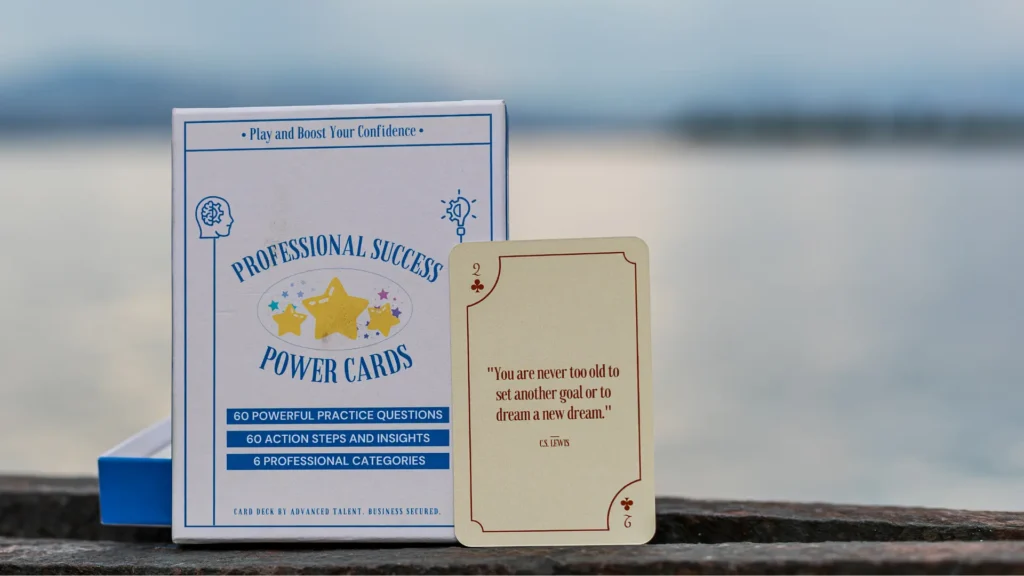
This is why I often work with clients on a tool I created, Professional Success Power Cards: a set of 67 cards packed with questions, insights, and action steps across six categories, including Self-confidence. You can take one card at a time, reflect on the question to gain insight about yourself, read the accompanying quote, or explore a recommended book on each card.

By doing this, you are reminding yourself what you already bring to the table. You don’t have to try to convince yourself that you are better than someone younger.
Myth 2: “The Swiss Job Market Only Wants Young Talent”
Some roles need fresh technical knowledge. Others need something that takes years to develop.
Senior positions often require sound critical thinking, credibility, patience, and the ability to manage complex relationships.
Experienced professionals can also demonstrate something important through their career history. They have already shown commitment.
Many of the professionals I coach and mentor have spent years with the same employers. In some cases, I would even say they have been too loyal.
That history can show a Swiss employer that you are not simply looking for the next opportunity. You know how to commit, build relationships, and grow within an organisation.
Myth 3: “It Is Too Late to Learn Something New”
I still meet professionals in their 40s and late 50s who are studying again.
Some complete a new degree. Others gain a Swiss qualification, improve their language skills, or update their technical knowledge.
There is nothing unusual about learning at this stage of your career.
In fact, experience can make learning easier because you already have a framework for understanding new information. You know how you learn best, and you can connect new knowledge with years of practical experience.
You do not need to know everything.
You need to remain curious and willing to learn.
Myth 4: “I Should Be Further Along by Now”
This may be the most damaging myth because it turns someone else’s career into the measure of your own.
You see a former colleague get promoted. Someone your age already has a senior role in Switzerland. Another person seems to have found a job within weeks.
Then, the limiting beliefs begin.
“Maybe I made the wrong choices. Maybe I am behind. Maybe I am no longer good enough.”
I see how quickly this kind of comparison can affect confidence. And once confidence drops, it often changes how you network, apply, and show up in interviews.
Your career does not need to follow someone else’s timeline.

The more useful question is not where you think you should be by now.
It is where you want to go from here.
What Starting Over Actually Looks Like in Switzerland
Once you understand that you are not starting from zero, the next step is understanding the market you are entering.
From both my own experience and from coaching professionals here, I have seen that Switzerland rewards patience, preparation, and relationships. You need to understand how the market and the culture work rather than simply repeat the job search strategy that worked elsewhere.
The Hidden Job Market And Why You Need More Than Applications
Networking is another important element next to applications in Switzerland.
It matters enormously, especially for experienced professionals. Senior opportunities can develop through referrals, internal conversations, and professional relationships before a vacancy reaches a public job board.
However, that does not mean applications no longer matter.
Even with a strong network, you may still need to go through a formal application process. Your CV, positioning, and interview preparation still need to be strong and aligned with Swiss expectations.
I encourage my clients to work on both sides. Build relationships that create opportunities, and be ready to apply effectively when those opportunities appear.
Professional organisations such as SwissICT and Swissmem can help you become part of relevant professional communities. However, simply adding a membership to your CV will achieve very little.
The value comes from participating, meeting people, contributing, and becoming someone others begin to recognise.
If you want to explore this further, I have written a complete guide on building a professional network in Switzerland.
Swiss Hiring Timelines And Why Patience Is Essential
One of the hardest adjustments I see among professionals coming to Switzerland is the pace of hiring.
It can be slow.
For senior positions, a hiring process may take several months. There may be several interviews, internal discussions, assessments, and long periods when very little seems to happen.
This is why I tell my clients not to measure progress only by how quickly they receive an offer.
Persistence matters more than speed.
At the same time, your job search should not take over your entire life. A long search becomes much harder when every day revolves around applications, LinkedIn, and waiting for replies.
Maintaining a healthy balance between work, life, and yourself is part of making the process sustainable.
You can also download my Worklife Integration Worksheet, which is designed to help you create more harmony between these areas while navigating a transition.
The CV Culture And What Swiss Employers Expect
Your CV may have worked extremely well in another country and still struggle to get attention here.
Swiss CVs tend to be structured, clear, and conservative. They also need to comply with ATS (applicant tracking systems).
However, adapting and tailoring your CV means more than changing its format.
I often see experienced professionals trying to fit twenty or thirty years of work into one page or one document. The result can become a long history of responsibilities instead of a clear argument for why they are right for this particular role.

Your CV should make your relevant experience easy to understand and connect your achievements to what the employer needs now.

If you want to work on this yourself, my 3 Day Swiss CV Challenge walks you through the process.
Language And Multilingualism
Language can have a major impact on your opportunities in Switzerland.
In German-speaking Switzerland, German can significantly expand the roles available to you. In Romandie, French plays the same role.
There are also international environments where English is the main working language. You will find these particularly in areas such as pharma, biotech, finance, and technology.
I always encourage people to look at the reality of their target market rather than make assumptions.
Study the vacancies you genuinely want. Speak with people already working in your field. Look at which languages employers repeatedly request.
Then you can make an informed decision about where improving a local language fits into your strategy.
A Brief Note About Work Permits
For professionals from outside the EU and EFTA, the job search can be more complicated.
Employers face additional requirements when hiring third-country nationals. This means your permit situation can influence which companies and roles are realistic targets.
Highly qualified and senior professionals can still be hired, particularly when they bring specialised experience that is difficult to find locally.
I have worked with professionals facing this exact challenge, and I do not believe the answer is to give up before you begin.
You need to be realistic about the additional hurdle and make your value to an employer exceptionally clear.
What Actually Changes After 40? It Is Not What You Think
When people talk about changing careers after 40, the conversation often focuses on what becomes harder.
I see something different in my coaching work. What changes most is not your ability to build a successful career. It is your definition of what a successful career should look like.

After years of working, achieving, and learning, you often start asking better questions.
The Shift from Status to Meaning
Earlier in your career, the next promotion or bigger title may have felt like the natural measure of progress.
After 40, many professionals I work with begin to question that definition.
They still want to succeed. However, success may now mean having interesting work, more flexibility, financial stability, or enough time and energy for life outside work.
This becomes especially important after an international move.
If you are rebuilding your career in Switzerland anyway, you have an opportunity to ask a question you may not have asked for years.
Do I actually want to recreate the career I had before?
Sometimes, the answer is yes. Sometimes, it is very clearly no.
Starting over can permit you to make more intentional choices instead of automatically chasing the next title.
And once status becomes less important, another question naturally takes its place.
What do you want your work to contribute?
The Shift from Ego to Impact
I often see experienced professionals become more selective about where they invest their time and energy.
They want their work to mean something. They want to use what they have learned to solve meaningful problems, support others, or leave something valuable behind.
This is also where work-life balance and fulfillment become harder to ignore.
A role can look impressive on LinkedIn and still leave you exhausted or disconnected from the rest of your life. A different role may come with less status, but give you greater purpose, flexibility, and satisfaction.
For some people, income remains the priority. For others, the question becomes not only what a job pays, but what that job adds to their life.
That change in priorities also affects how quickly you feel you need to move.
The Shift from Speed to Depth

Earlier in your career, progress may have meant moving upwards as quickly as possible.
After 40, you have already spent years proving that you can perform, learn, and take on responsibility.
You may no longer need every career decision to move you one step higher on the ladder.
Instead, you can go deeper.
You can become a stronger expert. You can mentor others. You can choose projects where your experience genuinely matters. You can take a role that gives you room for your family, your interests, or something you want to build outside work.
I see this as one of the advantages of experience.
You can stop asking how quickly you are moving and start asking whether you are moving in the right direction.
And that shift matters when rebuilding a career in Switzerland. The goal is not simply to find another job as quickly as possible.
It is to understand what you want this next chapter to give you, then, build your search around that.
Why Swiss Employers Hire Experience Differently
By this stage in your career, experience is much more than the number of years on your CV.
What matters is what those years have taught you to handle.
When I work with senior professionals, I often encourage them to stop thinking about experience as a list of previous positions. Instead, we look at the business value behind those years.
Experience as a Business Advantage
Think about how differently you respond to a difficult situation today compared with twenty years ago.
You have probably dealt with restructures, difficult stakeholders, failed projects, changing priorities, demanding clients, or unexpected crises. You know that not every problem has a perfect solution.
That judgment has value.
The same applies to relationships. After years of working with different personalities and priorities, you learn how to build trust, influence decisions, and recognise when to push and when to listen.
For international professionals, there is another advantage.
Many of the people I work with have already worked across countries, cultures, and languages. They know that the same communication style does not work everywhere. Above all, in Switzerland, demonstrating cultural awareness: understanding local norms, indirect communication, and consensus-driven decision-making, is all essential.
In a multilingual and international business environment like Switzerland, that ability to bridge differences can be extremely valuable.

The challenge is that employers cannot automatically see any of this when they look at your job titles.
You have to translate your experience into value they can understand.
How to Translate Your Experience for Swiss Employers
This is where I see many experienced professionals undersell themselves.
Their CV tells me what they were responsible for, but not what changed because they were there.
Instead of listing everything you managed, show the outcome.
Did you reduce costs? Improve a process? Retain an important client? Lead a team through change? Enter a new market? Deliver a difficult project under pressure?
Whenever possible, make the result concrete with numbers, percentages, team sizes, budgets, or other relevant measures.
However, do not simply fill your CV with impressive figures. Connect those achievements to the problems your target employer needs you to solve. In addition, your professional development such as taking courses, earning a new degree/certificates, and leadership impact should also be highlighted.
This requires tailoring.
Study the role and the company. Pay attention to the language they use. Then decide which parts of your experience provide the strongest evidence that you can help them.
I often tell my clients that the goal is not to make an employer understand everything you have done during the last twenty years.
The goal is to make them understand why those twenty years matter to them now.
Rebuilding Does Not Mean Repeating
Once you recognise the value of your experience, there is another question worth asking.
Do you actually want to rebuild what you had before?
I see many professionals arrive in Switzerland with one clear goal. They want the same level, the same type of company, and ideally the same career they had back home.
That is understandable. You have spent years building that career, so recreating it can feel like the safest definition of success.
However, sometimes, trying to recreate the past limits what you can build next.
I have seen experienced professionals discover that they want something different at this stage of their lives. Some move into consulting. Some step into leadership in a different environment. Others choose smaller organisations where they can have more influence and flexibility.
And some finally explore the business idea they have been postponing for years.
This connects directly to the questions we explored earlier about meaning, impact, and work life balance.
After 40, you know much more about yourself. You know which environments bring out your best work. You know what drains you. You also have a clearer sense of what you are no longer willing to sacrifice for a title.
So instead of asking how you can get your old career back, I encourage you to ask something different.
What would I build now, knowing everything I know today?
Starting over in Switzerland does not have to mean rebuilding the same professional life in a different country.

Sometimes, it allows you to build one that fits you better.
A Practical Roadmap for Rebuilding Your Career in Switzerland
Knowing that you want a change is one thing. Knowing what to do next can be much harder.
When everything feels important, it is easy to try everything at once. In my coaching work, I prefer to break the process into a few clear steps.
Step 1: Reconnect with What You Want
Before changing your CV or sending another application, ask yourself a simple question.
What really matters to me now?
This can be surprisingly difficult to answer. When many paths seem possible, everything can start to feel equally important.
I help my clients separate what they truly want from what they believe they should want. We look at the kind of work they enjoy, the environment they need, the impact they want to make, and what matters outside their career, too.
Clarity does not mean having your next ten years planned.
It means knowing what matters enough to guide your next decision.
Step 2: Position Your Experience for the Swiss Market
Once you know where you want to go, you can decide which parts of your experience support that direction.
Your CV and LinkedIn profile should not simply document your past. They should help an employer understand where you can add value next.
Personal branding matters here, too.
Your LinkedIn profile, professional photo, headline, About section, and the way you communicate your expertise should tell a consistent story.
I have seen how much difference the right image can make, especially for senior professionals. A professional photo should still feel like you while communicating the confidence and credibility you want associated with your work.

If this is something you’re looking for, you can explore Adrian’s personal branding photography service.
Step 3: Build Swiss Credibility
If your experience comes mainly from outside Switzerland, look for ways to “glocalize” your value i.e., transition from glocal to local experience.
That might mean volunteering, contributing to an industry project, speaking at an event, or sharing your expertise on LinkedIn.
Professional associations can also help. Depending on your field, that might be SwissICT, Swissmem, or a smaller organisation that is more relevant to your profession.
The goal is not to collect activities for your CV.
The goal is to participate in your professional community and give people a chance to see what you can contribute.
Step 4: Build Visibility in Switzerland
Credibility becomes much more useful when people know you exist.
Attending events can help, but I often remind my clients that simply being in the room is not networking.
The important work often happens afterwards.
Find the person you spoke with on LinkedIn. Send a short message while the conversation is still fresh. Continue the discussion. Stay in touch when there is a genuine reason to do so.
And before you attend an event, prepare your elevator pitch. You should be able to explain naturally who you are, what you do, and what direction you are exploring.
You can build visibility online as well. Comment thoughtfully on LinkedIn. Share your expertise. Join relevant conversations instead of only appearing when you need a job.
Recognition usually comes from small actions repeated consistently.
Step 5: Take It One Step at a Time

You do not need to solve your entire career transition this week.
One useful conversation can lead to another. One carefully targeted application can teach you more than ten rushed ones. One hour of reflection can stop you from spending months pursuing the wrong direction.
This is something I regularly remind the professionals I coach.
You do not need to see the whole path before you start walking it.
Choose the next useful step, take it, learn from what happens, and then decide what comes next.
Real Stories, Professionals Over 40 Who Made It Work
Career transitions after 40 rarely follow a straight line.
I have worked with professionals who initially believed they needed to find the next version of their previous job. Once we started exploring their experience, priorities, and options, they discovered that the next chapter could look very different.
Two stories come to mind.
Jerome, From 25 Years in IT to a More Flexible Career
Jerome, whose name I have changed for privacy, came to me through his career transition package after leaving Cisco.
He had spent 25 years with the company.
When you have been part of one organisation for that long, losing the role is about much more than finding another job. Your professional identity, routines, relationships, and sense of stability have all been connected to the same company for decades.
So our work was not simply about getting Jerome back into another full-time corporate position as quickly as possible.
We looked at what he wanted from this stage of his career and how he could use the experience he had built over 25 years without automatically recreating his old working life.
He eventually chose a more flexible path.
Jerome joined a startup part-time while also exploring his own consulting direction. At the same time, he remained active in the job market rather than closing the door on other opportunities.
I think his story is a great example of why rebuilding does not have to mean immediately choosing a single permanent answer.
Sometimes the right next step is creating enough flexibility to explore what comes next.
Fiona, Turning 20 Years of Medtech Experience Into New Options
Fiona, whose name I have also changed, was referred to me by another client who had successfully found a new role.
She came to our first clarity call with 20 years of experience in Medtech and an important decision ahead of her.
Her existing role was being moved remotely to the US. She could technically continue working, but the time difference did not fit the life she wanted. She was also dealing with significant pressure and burnout.
At the same time, she was considering other jobs.
During our clarity work, I encouraged her to look beyond whether she could do a particular role. Instead, we explored whether she actually wanted it.
She applied for one position and completed a simple exercise around it.
What did she like about the opportunity? What did she not like? What would she be gaining, and what would she be accepting simply because it felt like the logical next step?
That process helped make her priorities much clearer.
Fiona eventually decided to leave her existing role.
But she did not immediately replace it with another version of the same career.
She started developing a company she had already created but had never actively pursued. This gave her space to explore entrepreneurship and consider how she wanted to use her experience differently.
Then another opportunity appeared.
Fiona joined a smaller company within her field, working with a founder she had known professionally many years earlier.
Her story brings together several themes I see repeatedly in career transitions after 40.
Her network mattered. Her 20 years of experience mattered. But before either could help her, she needed clarity about what she wanted her working life to look like now.
The Bottom Line: It Is Never Too Late
If there is one thing I want you to take away from this article, it is this.
You are not too old, and it is not too late.
I have worked with enough experienced professionals to know that starting again after 40 can be unsettling. You may question your decisions, your confidence, and sometimes even the value of everything you have achieved so far.

However, you are not arriving at this transition empty-handed.
You bring years of experience, critical thinking, perspective, relationships, successes, and mistakes you have learned from. These are not things someone can gain from a course or a new qualification. They are earned over time.
Your experience is not something you need to apologise for or hide. It is an asset, as long as you learn how to use and communicate it in the right way.
Starting over in Switzerland after 40 is not about trying to become younger or competing with the person you were twenty years ago.
It is about understanding who you are today, what matters to you now, and where everything you have learned can create the most value.
Your next chapter may look different from the one you imagined.
That does not make it a step backwards.
It may be the first time you are building your career with a clear understanding of who you have become.
Frequently Asked Questions About Starting Over After 40 in Switzerland
These are some of the questions I hear regularly from experienced professionals considering their next move in Switzerland.
Is It Really Possible to Start Over in Switzerland After 40?
I have been constantly working with professionals in their 40s and 50s who have found new roles, changed direction, explored consulting, or built a different version of their careers.
The key is to stop treating your age as the problem. Focus instead on your positioning, your network, your Swiss market knowledge, and how clearly you communicate the value of your experience.
You are not starting from zero. You are starting with experience.
What Industries Are Most Welcoming to Older Professionals?
There is no single industry where age stops mattering.
However, experience can be particularly valuable in roles where employers need strong judgment, technical expertise, leadership, stakeholder management, or deep industry knowledge.
This can include areas such as finance, pharma, engineering, technology, consulting, manufacturing, and professional services.
I would not choose an industry simply because it appears more welcoming to experienced professionals. Look instead for the places where your specific experience solves a valuable problem.
That is a much stronger position from which to search.
Do I Need to Learn German to Find a Job?
It depends on where you live, your industry, and the roles you are targeting.
In German-speaking Switzerland, German can open significantly more opportunities. In Romandie, the same is true for French.
There are international companies where English is enough, particularly in sectors such as pharma, biotech, finance, and technology. But I always encourage my clients to look at the actual vacancies in their target market.
If the local language appears repeatedly, take that information seriously.
You do not necessarily need to wait until you are fluent before looking for work. You can improve your language while continuing to build your network and search for opportunities.
How Do I Address Age Bias in Interviews?
You cannot control every assumption an interviewer may have about age.
You can control the story you tell about yourself.
Do not enter an interview trying to defend your age. Show curiosity, energy, confidence, and a willingness to learn.
Talk about recent achievements, current skills, and the problems you can solve now. Demonstrate that your experience gives you perspective without making you resistant to new ideas.
This is also why I put so much emphasis on confidence during interview preparation.
Your goal is not to prove that age does not matter. Your goal is to make your value difficult to overlook.
How Long Does It Typically Take for Professionals Over 40 to Find a Role in Switzerland?
There is no reliable timeline that applies to everyone.
From what I see, three to six months can be realistic for some professionals, while others may need six to nine months or longer.
A lot depends on when the person starts positioning themselves effectively for the Swiss market. Your seniority, industry, language skills, permit situation, network, and target role can all influence the timeline.
This is why I encourage people not to measure their search against someone else’s.
If you want to understand the factors behind these timelines, I explain them in more detail in my guide on how long it takes to find a job in Switzerland.
Should I Consider a Career Change at This Stage?
Possibly, but not simply because your current search is difficult.
A career change makes sense when your priorities, interests, or goals have genuinely changed.
Before deciding that you need an entirely new career, look carefully at what you already have. Your next move may involve transferring your skills into another industry, moving into consulting, taking a different type of leadership role, or changing the environment in which you work.
Sometimes, you need a new career.
Sometimes, you simply need a better use for the experience you already have.
Can a Career Coach Help Me With This Transition?
A career coach can give you something that is difficult to create when you are inside the situation yourself.
Perspective and clarity.
In my work, I help professionals clarify what they want, identify the value in their experience, position themselves for the Swiss market, strengthen their confidence, and build a practical strategy for moving forward.
A coach cannot guarantee you a job. But the right support can help you stop wasting energy on strategies that are not working and become much more intentional about the ones that are.
If you are unsure what your next step should be, you can book a clarity call with me.
Add Pamela Dobay’s review here
Ready to Build Your Next Chapter in Switzerland?
If this article resonated with you, know that you are not alone.
I speak with many professionals over 40 who arrive in Switzerland wondering whether they have left it too late to rebuild their careers.
They have not.
Neither have you.
Your experience, wisdom, and judgment cannot be replaced. They have been built through years of decisions, challenges, successes, and lessons.
The question now is how you want to use them.
You do not need to recreate your old career. You do not need to have your entire future figured out today.
You need clarity about what matters next and a strategy that helps you move towards it.
If you would like support in building that next chapter, I would be happy to help.
You can book a clarity call with me here and we can explore what your next step could look like.