
“Finally, I could talk to a human.”
A client wrote this to me after finally landing a new role.
He was not new to Switzerland. He had already worked here for several years before being laid off. Yet after more than a year of searching, this simple sentence said a lot about what the experience had done to him.
I hear versions of this all the time…
You may have spent 15 or 20 years building a career. People knew your work. Colleagues trusted your judgement. Recruiters approached you. You had a reputation that had grown through years of results, relationships and experience.
Then, something changes.
You move to Switzerland. You follow your spouse. Or you decide it is time for a new professional chapter.
Suddenly, you are introducing yourself again.
You are explaining companies nobody here knows. You are trying to put years of experience into a few lines on a CV. You send applications and hear nothing back. You reach out to people who have no idea what you have achieved before.
You know you are still the same capable professional. Yet the signals that used to confirm that seem to have disappeared.
This is where many experienced professionals start questioning themselves.
However, something important has changed that has nothing to do with your ability.
The context has changed.
Your professional identity was built over years around people who knew your work, understood your industry, and recognised what you brought to the table. When that context disappears, your experience does not disappear with it.
You have not lost your value. You have lost the local recognition of that value.
That difference matters.
Because if you believe you have lost your value, you may start making yourself smaller. If you understand that you have lost recognition, you can begin rebuilding it.
In this article, we will look at why relocation can shake your professional identity, how that can affect your career decisions, and how you can rebuild your sense of who you are professionally in Switzerland.
TL;DR — Key Takeaways
Moving to Switzerland can make you feel like you have lost your professional identity.
You have not lost your value. You have lost the local recognition of that value.
- Your reputation is often local. Your experience travels with you — the recognition of it does not.
- Being unknown is not the same as being unqualified.
- Rebuilding starts with reconnecting with your strengths, not reinventing yourself.
- Recognition grows gradually, through conversations and relationships.
- You are not starting over. You are starting from experience.
You are not lost. You are becoming.
Why Moving to Switzerland Can Affect Your Professional Identity
A career is not built through experience alone.
Over time, people get to know your work. Colleagues trust you. Clients remember what you delivered. Your network knows what you are good at and may recommend you when an opportunity appears.
All of this becomes part of your professional identity.
When you move to Switzerland, much of that context stays behind.
Your experience travels with you. Your reputation does, too, but the people around you may have no connection to either yet.
Your reputation may be strong, but its recognition is often local.
This can create a strange gap between how you know yourself professionally and how the new market sees you.

That gap is not a reflection of your value. It is often a reflection of your visibility.
Professional Identity Is Built Through Context
Think about how your professional reputation developed before you moved.
Perhaps a former colleague would immediately describe you as the person who could turn around a difficult project. A manager knew they could trust you with an important client. Someone in your industry might mention your name when another company needed your expertise.
You did not have to explain all of this every time you entered a room.
People already had context.
After moving to Switzerland, that context may no longer exist.
You are still the person who solved those problems and achieved those results. But you are now surrounded by people who did not witness them.
This is one reason relocation can affect professional identity so deeply.
You have not suddenly become a different professional.
You are the same professional in a context where fewer people know your story.
Your International Experience May Not Be Recognised in Switzerland
There is another challenge.
The companies, projects and achievements that carried weight in your previous market may not have the same meaning to a Swiss employer.
You might mention a respected company from your home country and expect the name to speak for itself.
It may not.
Or you might say that you managed a major project without explaining what made that project complex, how large it was or what changed because of your work.
The achievement is still real. The problem is that the person reading your CV may not have enough context to understand its value.
This is why international experience often needs translation.
Not language translation.
Professional translation.
You need to help people understand what you did, the problems you solved and why that experience matters in their world.
When You Go From Being Sought Out to Seeking Opportunities
This can be especially difficult for experienced professionals.
Perhaps you spent years being approached by recruiters. Former colleagues recommended you. People called you when they needed advice or wanted you to join a project.
Then, suddenly, you are the one reaching out.
You are sending applications. You are introducing yourself to strangers. You are asking people for conversations and explaining why your experience might be relevant.
That shift can be humbling.
And it is not limited to expats.
Swiss professionals can experience something similar after a layoff, especially after many years with the same employer. A professional network that once felt strong may suddenly seem much smaller when you need to find your next opportunity.
For someone who has also moved countries, there can be another layer.
You may be rebuilding without the professional relationships that supported you before.
Going from being sought out to seeking opportunities does not mean your career has gone backwards.
It means the context around your career has changed.
How Language and Cultural Differences Affect Your Career in Switzerland
Another important challenge is learning how professional relationships work in a new culture.
Sometimes the differences are obvious.
Language is one example.
You may be an excellent communicator in your own language, yet feel less confident explaining a complex idea in German or French. It can be frustrating when you know exactly what you want to say but cannot express it with the same depth or personality.
Other differences are much more subtle.
Switzerland is a small country, but its professional culture is not the same everywhere. The way people communicate, build trust and make decisions can feel different depending on whether you work in the German-, French- or Italian-speaking region.
These differences are not strict rules. Your experience will also depend on the company, industry and people you work with. But understanding some of the common tendencies can help you make sense of behaviours that may otherwise feel unfamiliar.
The table below shows some of the differences you may notice across the three main language regions of Switzerland. This is the observation noted in my academic research considering various cultural models, and the regional descriptions are intended as broad cultural tendencies, not fixed characteristics of individuals.
Professional culture across Switzerland’s Linguistic Regions – Practical Tendencies
| Area | Swiss German | Swiss French | Swiss Italian |
|---|---|---|---|
| Building relationships | Friendly but often reserved. Trust tends to build slowly. | Friendly and more socially open. Trust still takes time. | Often warm and personal. Relationships can play an important role in building trust. |
| Small talk | Usually limited in professional settings. Conversations tend to stay focused. | More common. Social conversation can sit alongside business discussion. | More common and often an important part of creating rapport. |
| Communication | Polite, formal, and to the point. Often indirect when disagreement is involved. | Polite and somewhat more expressive, while still professional. | Often more expressive and relationship focused, while remaining professional. |
| Self promotion | Modesty and understatement are valued. Strong self-promotion can feel uncomfortable. | Modesty is still valued, although communication may feel more socially expressive. | Personal warmth and confidence may be more visible, but credibility still matters. |
| Hierarchy | Hierarchies exist, but authority is often understated. Decentralised structures are common. | Hierarchy can be somewhat more visible and centralised. | Hierarchy may be more noticeable, depending strongly on the organisation. |
| Decision making | Preparation and consensus are important. Decisions may take time. | Consensus matters, with somewhat more room for spontaneity and creativity. | Relationships and discussion may play a larger role alongside formal decision-making. |
| Time and planning | Punctuality and planning are highly important. | Punctuality and planning are important, with slightly more flexibility. | Punctuality remains important professionally, although it may feel less rigid. |
| Feedback and disagreement | Often subtle and private. Facts tend to carry more weight than emotion. | Usually handled diplomatically and privately. | Often more expressive, but maintaining the relationship remains important. |
| What builds credibility | Competence, expertise, reliability and consistency. | Competence, expertise, trust and good relationships. | Competence, trust, personal relationships and reliability. |
| What may surprise newcomers | Reserved communication can be mistaken for lack of interest. | A warm interaction does not necessarily mean trust has already been established. | A warmer communication style does not mean professional expectations are less important. |
For an international professional, these differences can create another layer of uncertainty.
Even something as simple as presenting your achievements can become confusing.
In one professional culture, confidently describing your impact may be expected. In another, the same language might sound exaggerated.

You may start wondering how much to say, how directly to say it and how to demonstrate confidence without appearing boastful.
Decision-making can feel different too. Consensus, preparation, and clear responsibilities often matter. Professional relationships may develop more slowly than you expect.
Suddenly, skills that once felt automatic require more thought.
- How do I introduce myself?
- How much should I talk about my achievements?
- Should I contact this person directly?
- Am I being too confident?
- Or not confident enough?
This can make you feel like a beginner even when you have decades of professional experience.
But you are not learning your profession again.
You are learning how to express that professional identity in a different environment.
That is an important distinction.
You are not doing it wrong. You are learning a new professional language.
What Happens When Your Professional Identity Is No Longer Recognised?
At first, the change can be subtle.
You send a few applications and hear nothing back. A conversation does not lead anywhere. Someone with less experience seems to move forward faster than you.
None of these things says much about your professional value on its own.
When you are already in a new environment where few people know your work, they can start to influence how you behave.
When your identity is not recognised, your willingness to take action can quietly shrink.

And that matters because rebuilding a career requires you to do exactly the opposite. You need to be visible, have conversations, explore opportunities and keep putting yourself forward.
You Start Questioning Your Professional Value
After enough silence or rejection, questions can start creeping in.
Does my experience actually matter here?
Are my skills relevant to the Swiss market?
Am I really qualified for this level of role?
Those questions can then show up in your applications and interviews.
You may describe your achievements more cautiously. You may undersell the size of your responsibilities. In an interview, you may focus more on proving that you fit than explaining the value you can bring.
Your experience has not changed.
But the way you communicate it has.
You Become Hesitant to Put Yourself Forward
The next step is often hesitation.
You find an interesting role, but instead of applying, you spend another hour checking whether you meet every requirement.
You think about contacting someone in your industry, but decide you should wait until you have something more useful to say.
You see an event that could introduce you to the right people, but convince yourself it probably will not lead anywhere.
Each decision seems small.
Together, they reduce the number of opportunities you create for yourself.
This is one of the hidden costs of losing professional recognition. You can become more cautious at exactly the moment when you need to explore.
Networking Becomes More Difficult
Networking is especially hard when you are not clear about how you see yourself professionally.
Someone asks what you do.
It used to be an easy question.
Now you might find yourself explaining your previous role, why you moved to Switzerland, what happened since then and what you are looking for next.
By the time you finish, you may feel that you have explained your entire career without really communicating who you are.
That discomfort can make networking feel like another form of job hunting.
So, you do less of it.
However, this can create a difficult cycle.
Fewer conversations mean fewer opportunities for people to discover your expertise. That means less feedback, fewer new relationships and fewer moments when someone recognises what you can bring.
Less visibility then reinforces the feeling that your professional identity is no longer recognised.

Career Setbacks Start to Feel More Personal
Rejection is part of almost every job search.
However, rejection can feel very different when your professional identity already feels uncertain.
Before, you might have looked at a rejection and thought that the role simply was not the right fit.
Now, the same rejection can feel like evidence.
- “Maybe employers here do not value my background.”
- “Maybe my experience is too international.”
- “Maybe I am too senior.”
- “Maybe everyone else has something I do not.”
This is also where comparison can become particularly damaging.
You see someone announce a new role on LinkedIn. You hear that another expat found a job after only a few months. Someone from your former company seems to have moved effortlessly into their next position.
You see their result.
Then, you compare it with everything happening behind the scenes in your own search.
The danger is not simply that this makes you feel bad.
It can change your behaviour.
You apply less. You reach out less. You become more cautious about opportunities. You may even start aiming lower because you assume the market has already told you what you are worth.
However, silence, rejection and a slower transition are not reliable measures of your professional value.
They tell you that something in your current approach, positioning, network or market context may need attention.
They do not tell you who you are as a professional.
Recognising that difference is where rebuilding can begin.
If you want to explore why comparison can become so intense for expats in Switzerland, what it can quietly cost you, and how you can stop measuring your progress against someone else’s timeline, don’t miss this ARTICLE.
How to Rebuild Your Professional Identity in Switzerland
If you have started questioning yourself, the natural reaction may be to think you need to reinvent yourself.
Maybe you need a new qualification. A different profile. A stronger personality. Perhaps you need to become someone who fits the Swiss market better.
However, rebuilding your professional identity does not have to start with changing yourself.
Rebuilding your identity is not about creating something new. It is about reconnecting with who you already are.
You already have years of experience behind you. The first step is learning to see that experience clearly again, without measuring it only through your current job search.
Separate Your Professional Identity From Your Visibility
Visibility and identity are connected, but they are not the same thing.

Visibility is often about who knows you and what they know about you.
Professional identity goes deeper. It includes your strengths, experience, values, expertise and the kind of problems you know how to solve.
When you enter a new market, your visibility can drop almost overnight.
Your professional identity does not.
This distinction is important because being unknown can easily start to feel like being unqualified.
They are not the same.
You can have very little recognition in Switzerland and still be the same capable professional who led teams, solved difficult problems and earned the trust of colleagues elsewhere.
Before asking how to make other people see your value, reconnect with it yourself.
Reconnect With Your Strengths, Skills and Achievements
After months of looking at job descriptions, it is surprisingly easy to start seeing yourself through lists of requirements.
You notice what you are missing: German, Swiss experience, a particular qualification, experience in a certain industry…
What you may stop noticing is everything you already bring.
This is why I often encourage people to go back through their career and look for evidence.
Think about projects you are proud of. Difficult situations you handled. Problems people repeatedly came to you to solve.
Then, go one step deeper and reflect on:
- What skills allowed you to do those things?
- What strengths appear again and again?
- What do people consistently trust you with?
One tool I use with clients is called Professional Success Power Cards.
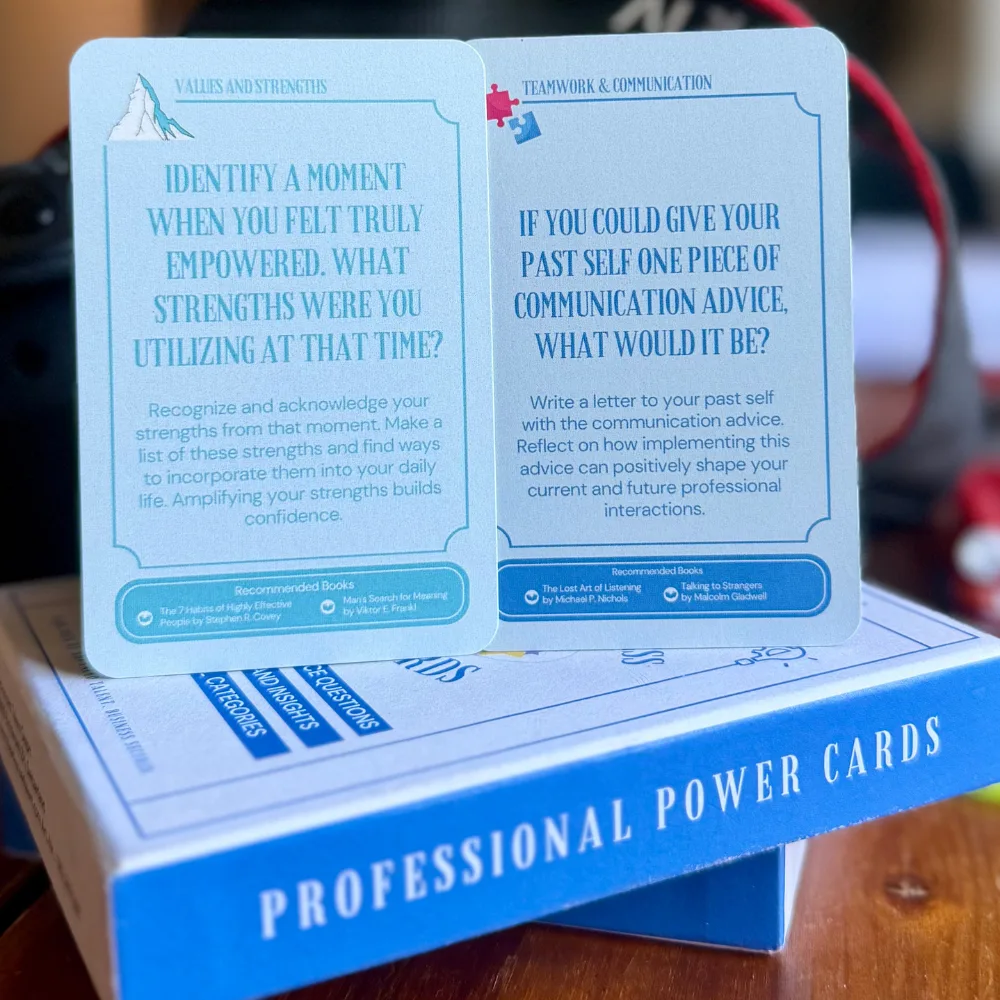
There are Power Cards with prompts related to Values and Strengths to help you connect your strengths to something you actually did.
For example, perhaps you brought together a team during a difficult transformation.
The achievement matters.
So do the abilities underneath it, such as building trust, handling uncertainty, influencing people and keeping a team focused.
When you collect enough examples, patterns begin to appear.
Those patterns tell you much more about your professional identity than your latest job title does.
Build New Professional Reference Points
Your previous professional identity was reinforced by other people.
A manager trusted you with an important project. A colleague asked for your opinion. A client thanked you for solving a difficult problem.
Those moments became reference points. They helped confirm what you already knew about yourself.
After relocation, many of those reference points are far away, so part of rebuilding your identity means allowing new ones to develop.
This does not have to begin with someone offering you a job.
It might be a conversation where someone understands your expertise, positive feedback on an idea you shared, or simply hearing someone say, “You should speak to this person.”
These moments can seem small.
But each one gives you new evidence that your professional value still exists in this new environment.
Over time, Switzerland stops being a place where nobody knows what you can do.
It becomes another place where people have experienced your value for themselves.
Create a Narrative That Reconnects Your Past and Future
A career transition can leave your story feeling fragmented.
Instead of asking only, “What job did I have?”, look for the thread running through your career.
- What problems have you repeatedly solved?
- What kind of work gives you energy?
- What have different roles taught you?
- Which parts of your experience do you want to carry forward?
Your story does not need to explain or defend every career decision.
It needs to help people understand where you have come from, what you bring, and where you want to go next.
More importantly, it should make sense to you.
When your own story becomes clearer, introducing yourself becomes easier because you are no longer trying to squeeze your identity into your previous job title.
You know what connects your past to your future.
Gradually Rebuild Recognition
There is rarely one moment when your professional identity suddenly feels restored.
Recognition builds gradually.
One useful conversation leads to another. Someone remembers your expertise. A contact introduces you to another person. You contribute something valuable, and people begin to associate your name with what you do well.
This is why rebuilding recognition requires patience.
You may not always see progress while it is happening, but recognition is being built every time someone gets a clearer picture of who you are and what you bring.
You don’t have to try hard to recreate the reputation you had before, you need to allow a new professional community to discover the value that was already there.
Give Yourself Time to Rebuild Your Career in Switzerland

This process takes time, and it rarely moves in a straight line.
There may be weeks when you feel confident about your direction. Then, one rejection can make you question everything again.
That does not mean you are back at the beginning.
Pay attention to the smaller signs of progress, too, such as:
- You can explain your value more clearly than six months ago,
- You understand the Swiss market better,
- You now have people you can call for advice…
These changes matter.
They show that you are building up new branches on a foundation that already exists.
You Are Not Starting Over
It may feel like you are starting again, especially when you have to rebuild relationships, explain your experience and prove yourself in a new market.
But starting again is not the same as starting from zero.
You are not starting over. You are carrying everything you have learned, everything you have achieved, and everything you have become into a new context.
Your Professional Identity Is Evolving
Professional identity is not fixed.
The person you were ten years ago is probably not the professional you are today. Moving to Switzerland may simply make that evolution more visible.
You do not have to recreate exactly who you were before.
Some parts of your previous professional identity will still serve you. Others may no longer fit the life or career you want now.
You Can Decide What Comes Next
Relocation can create something that is difficult to see when you are struggling to find your place.
Choice.
You have an opportunity to ask questions that you may not have asked for years.
- What kind of work do I still want to do?
- What matters to me now?
- What do I want more of in the next chapter of my career?
- What am I ready to leave behind?

Your next chapter does not have to look exactly like the previous one to make everything before it valuable.
You Are Starting From Experience, Not Zero
Everything you learned before moving to Switzerland is still with you.
The things that took you 20 years to understand cannot be erased because you entered a new market.
That is your starting point.
Experience, not zero.
If you are navigating this transition later in your career, you may also find my article on starting over in Switzerland after 40 helpful. It explores this idea in more depth and shows why a new professional chapter does not mean throwing away everything that came before.
Conclusion
You Are Not Lost. You Are Becoming.
Moving to Switzerland can make you question a professional identity that once felt certain.
However, you have not lost who you are.
You have lost some of the context and local recognition that once reflected your value back to you.
Those things can be rebuilt.
And rebuilding does not begin with becoming more impressive. It begins with reconnecting with the experience, strengths, and values that are already yours.
From there, you can build something that fits not only the Swiss market, but also the person you are today.
If you are struggling to see what your experience adds up to or where your next professional chapter could lead, I invite you to book a strategy call with me.

Sometimes, you do not need another job search strategy.
You need the space to step back, reconnect the pieces, and see your career clearly again.
Frequently Asked Questions About Professional Identity in Switzerland
Moving to a new country can raise questions that go far beyond finding your next job. Here are some of the most common questions international professionals ask when rebuilding their careers and professional identity in Switzerland.
How can I rebuild my professional identity after moving to Switzerland?
Start by separating your identity from your visibility.
Being unknown in Switzerland does not mean you are less qualified or experienced. Reconnect with your strengths, achievements, and the problems you know how to solve.
Then begin building new professional reference points. Over time, new relationships, feedback, and experiences will help you feel recognised in your new environment.
Most importantly, give yourself time. You are not creating your professional identity from nothing. You are rebuilding recognition around the experience you already have.
Why do I feel like I have lost my professional identity after moving to Switzerland?
Professional identity is partly built through context.
Before moving, you may have had colleagues, clients and a network that knew your work and recognised your expertise. After relocating, much of that context disappears.
This can make you feel less established even though your skills and experience have not changed.
You have not lost your value. You have lost the local recognition of that value.
How can I make my international experience relevant to Swiss employers?
Do not assume that an employer will automatically understand the importance of a company, project or achievement from another country.
Give them context.
Explain the problem you faced, what you were responsible for and what changed because of your work.
The goal is not simply to list what you have done. Help the employer understand why that experience could be valuable to them.
How can I build a professional network in Switzerland after relocating?
Focus on relationships rather than collecting contacts.
Professional associations, industry events, and individual conversations can all help you meet people in your field. Approach these interactions with genuine curiosity instead of immediately asking for opportunities.
Be patient and consistent. Trust often takes time to build, and referrals become particularly valuable when you are establishing your reputation in a new professional community.
How can I improve my visibility in the Swiss job market?
Start by being present consistently.
Have conversations with people in your industry. Attend relevant events. Share useful ideas and expertise when you have something valuable to contribute.
You do not need to become the loudest person in the room.
Professional visibility is about helping the right people understand who you are, what you know, and what you can contribute.
How long does it take to rebuild your professional identity after relocation?
There is no fixed timeline.
For some people, the transition takes months. For others, it can take much longer.
Your industry, language skills, career level, existing network and personal situation can all influence the process.
Instead of measuring progress only by whether you have landed a job, notice the smaller changes too. A stronger network, clearer direction and greater confidence in explaining your value are all signs that your professional identity is taking root again.
Can a career coach help with a career transition in Switzerland?
Yes, especially when the challenge is no longer simply finding job opportunities.
A career coach can help you step back and understand what you want from your next chapter. They can also help you identify your strengths, make sense of your experience, and communicate your value more clearly.
Sometimes the most important part of a career transition is not deciding what to apply for next, but being clear about who you are professionally and where you want to go.