
You are scrolling through LinkedIn.

A former colleague has just announced a promotion. Someone you met at a networking event has landed a senior role. Another expat seems to have built an impressive career in Switzerland almost overnight.
And then, the thought appears.
What am I doing wrong?
Comparison is human. Although, I have seen how much more painful it can become when you are rebuilding your career in a new country.
When I work with experienced professionals in Switzerland, I often notice that they are not only comparing job titles or salaries. They are comparing how quickly they have settled in, how visible they are, and whether they seem to belong here.
That is a much heavier comparison.
You may have arrived with 15 or 20 years of experience. Yet suddenly, you are introducing yourself again, building new relationships, learning a new job market, and trying to explain your value to people who do not know your history.
Your experience did not disappear when you crossed the border. However, the context around that experience changed.
In this article, I want to explore why comparison can become so intense for expats in Switzerland, what it can quietly cost you, and how you can stop measuring your progress against someone else’s timeline.
Because feeling behind and actually being behind are not the same thing.
This is not a sign that you have become less confident or less capable.
It is a predictable response to a major transition. Relocation changes much more than your address. It changes the professional environment in which your experience was known and valued.
TL;DR
Moving to Switzerland can make even highly experienced professionals feel like they are falling behind. Your skills and experience come with you, but your reputation, network, and professional visibility may not.
Comparison becomes especially powerful when you see someone else’s success without seeing the uncertainty, rejection, and effort behind it.
The solution is not to stop comparing completely. Instead:
- Focus on your own definition of success.
- Compare your progress with where you were before.
- Be intentional about social media.
- Build relationships and visibility in Switzerland.
- Turn comparison into curiosity rather than self-judgement.
- Remember the experience and value you already bring.
Feeling behind does not necessarily mean you are behind. You may simply be in transition.
Why Comparison Feels Different When You’re an Expat in Switzerland
Before moving to Switzerland, you probably had reference points.
You knew how your industry worked. You understood what employers expected. You had colleagues who knew your work and people you could call when you needed advice or an introduction.
After relocation, many of those reference points disappear.
You may still have the same experience, skills, and achievements. But fewer people around you know about them.
At the same time, you are trying to understand a new job market. Hiring can take time. Communication styles may feel different. Even something as simple as introducing yourself professionally can suddenly require more thought.
Then, you open LinkedIn.
You see someone announcing a new role. Another person has been promoted. An expat you met a few months ago seems to be doing incredibly well.
What you usually do not see is what happened before that announcement.

You do not see the months of searching, the unanswered applications, the introductions that went nowhere, or the moments when that person questioned whether moving here was the right decision.
I see this often with the professionals I work with. They look at someone else’s visible result and compare it with everything happening behind the scenes in their own transition.
That is not a fair comparison.
There is also something deeper happening.
You are not only comparing your career progress. You may be comparing your ability to belong, to be seen, and to matter in this new environment.
That is why a simple LinkedIn announcement can hit harder than expected.
The question is no longer only whether someone else found a job faster than you.
It can quietly become whether they have figured Switzerland out and you have not.
They have not necessarily figured it out faster. You are simply seeing one part of their story while living every part of yours.
Losing the Professional Identity You Built Over Years
Your professional identity did not appear overnight.
You built it through years of work, relationships, results, and experiences. People knew what you were good at. Your name meant something within your professional circle.
Then, you moved to Switzerland.
Suddenly, you may go from being a respected expert to being someone nobody knows yet.
I see how uncomfortable this can be for experienced professionals. You know what you are capable of, but you no longer receive the same recognition from the people around you.
It can easily feel as though you have gone backwards.
However, there is an important distinction.
You have not lost your value. You have lost some of your visibility.
And visibility can be rebuilt.
The Swiss Job Market Takes Time to Navigate
The Swiss hiring process can also test your patience.
This is especially true for senior roles. You may go through several interviews, assessments, meetings, and long periods of silence before receiving a decision.
Sometimes, nothing seems to happen for weeks.
That is exactly when comparison becomes tempting.
Someone else gets an offer after two months, while you are still waiting for a second interview. It is easy to assume that they are doing something right and you are doing something wrong.
However, speed is not always a useful measure of progress.
I encourage my clients to focus more on whether their strategy is improving. Are they getting clearer about their positioning? Are they having better conversations? Are they reaching the right people? Are they learning from each interview?
In the Swiss job market, persistence often matters more than speed.

If interviews are part of your challenge, I have written a practical guide on how to ace a Swiss job interview.
You can also explore my Swiss Job Offer Generator course if you want a more structured approach to improve your interview performance.
Social Media Makes It Worse
LinkedIn can be useful during a career transition. At the same time, it can also become a daily scoreboard.
New job. Promotion. Award. Speaking event. Career milestone.
You see the announcement, but rarely everything that came before it.
There is another side of social media that I think deserves just as much attention.
Expat groups can become an endless stream of frustration and advice.
Someone says Swiss employers never hire people without German. Someone else says your CV must look a certain way. Another person says networking does not work. Then, someone shares that they have sent hundreds of applications without getting an interview.
Spend enough time reading these conversations and their fears can slowly become yours.
I am not suggesting that you ignore other people’s experiences. Some communities can be incredibly helpful.
However, remember this: Their story is not your story.
Their industry may be different. Their experience may be different. Their language skills, network, permit, positioning, and goals may be different too.
Be intentional about what you consume when you are already feeling uncertain.
The Fresh Start Illusion
There is often a big gap between how someone’s transition looks and how it actually feels.
You meet another expat who already has a great role, a network, and an active social life. From the outside, it looks effortless.
However, people naturally share rewards and recognition more often than fear and insecurity.
They announce the offer.
They rarely announce the evening when they wondered whether they would ever find one.
You usually do not see the rejected applications, uncomfortable networking conversations, uncertainty, self doubt, or comparison happening behind the scenes.
Of course, the opposite also happens.
You may see someone post that they have applied for hundreds of jobs without receiving an interview.
That story can frighten you just as much as someone else’s success can discourage you.
Neither story predicts yours.
You are seeing one person’s experience, not a rule about what will happen to you.
Different Communication and Visibility Norms
Relocation also means learning how people communicate and build professional relationships in a different environment.
Switzerland can feel more reserved professionally than other markets. Trust often develops gradually, and professional relationships can take time to deepen.
That can make visibility frustrating.
You may be attending events, reaching out to people, improving your LinkedIn profile, and having conversations without seeing an immediate result.
I often remind my clients that networking is not simply about collecting contacts. It is about becoming known and trusted over time.
I explain this process in more detail in my guide to building a professional network in Switzerland.
When the results are not immediately visible, it is tempting to look at someone else’s progress and assume you are falling behind.
But you may actually be doing exactly what this transition requires.
You are building recognition in a market where people do not know you yet.
And this is where the comparison trap becomes especially painful.
You know your experience has value. You have years of evidence behind you. Yet that value may not be recognised in your new environment yet.
That creates a particular kind of professional invisibility.
And it is worth understanding what that invisibility actually means.
The Invisible Expat When Your Experience Doesn’t Travel With You

Imagine you have spent 20 years building your career.
You have led teams, solved difficult problems, delivered results, and built relationships across your industry. People trusted your judgement. Former colleagues recommended you. Recruiters may even have approached you with opportunities.
Then, you move to Switzerland.
Your experience comes with you, but your reputation often does not.
I see this as one of the hardest parts of an international career transition. You still feel like the same professional, but the environment around you no longer reflects that identity back to you.
Your results are real, but Swiss employers may not know the companies you worked for or understand the context behind those results.
And perhaps most uncomfortable of all, you may be used to people coming to you.
Now you are the one applying.
You are the one asking for conversations, making introductions, attending events, and explaining what you can bring.
That shift can be humbling, especially at a senior level.
It can also make comparison much more tempting.
When the outside world is no longer giving you the professional validation you were used to, you naturally start looking for other ways to understand where you stand.
You look at former colleagues, other expats, people with similar backgrounds who seem to be progressing faster.
However, there is a problem with that comparison.
You are comparing all the invisible work happening in your career transition with the visible results of someone else’s.
They announce the new position.
You remember the ten conversations you had that led nowhere.
They celebrate a promotion.
You think about the applications that received no response.
They post a photo from a professional event.
You think about the networking event where you stood in a room wondering who to approach.
The comparison feels real, but the information behind it is incomplete.
This is why I believe visibility matters so much for expats.
You do not need to prove that your previous career mattered. You need to help people in your new market understand why that experience matters here.
That happens gradually.
One conversation leads to another. Someone remembers your expertise. A new contact introduces you to someone else. Your positioning becomes clearer. People begin to associate your name with what you do well.
Comparison thrives when you feel invisible.
As you become more visible, you have less need to constantly look at other people’s careers to understand your own progress.
You start creating your own reference points again.
Your Reputation Doesn’t Travel with You
Reputation is built in context.
It comes from people seeing your work, trusting your judgement, and recommending you to others. Over time, you no longer need to explain everything you can do. People already know.
When you move countries, much of that context disappears.
You may have an excellent reputation in London, Paris, Singapore, or New York. On the other hand, the hiring manager sitting across from you in Switzerland may have never heard your name before.
I often remind my clients that this does not mean their reputation has disappeared.
It means they need to build local recognition around the experience they already have.
You have not lost your experience. You have lost local recognition of that experience.
Those are two very different things.
Your Network Is Not Here
The same applies to your network.
You may know hundreds of people in your industry. You may have former managers, clients, colleagues, and partners who would happily recommend you.
However, many of them may not be in Switzerland.
This matters because trust and referrals play an important role in the Swiss job market. A recommendation from someone who already knows your work can open conversations that an application alone may not.
Building those relationships locally takes time.

This can make comparison particularly frustrating.
You see someone getting introduced to a hiring manager or hearing about an opportunity before it is advertised. It looks as though opportunities simply come to them.
What you may not see is the network behind that opportunity.
They might have spent years building those relationships.
If you arrived six months ago, comparing your network with theirs makes little sense.
Your task is not to catch up with them. It is to start building your own.
Your Track Record Is Not Visible Yet
You know what you have achieved.
The challenge is making those achievements clear to someone who has never worked with you.
Simply saying that you are an experienced leader or a strong project manager is rarely enough.
People need evidence.
What changed because of your work? What problems did you solve? What did you improve? What can you bring to an organisation in Switzerland today?
I spend a lot of time helping my clients translate their experience into this kind of evidence.
Your CV, LinkedIn profile, and professional conversations should make your track record easier to understand.
This is especially important when your previous employers or markets are unfamiliar to Swiss recruiters.
Until your experience becomes visible in the right way, it can feel as though nobody sees what you bring.
That feeling can quickly feed comparison.
From Being Sought Out to Being the One Seeking
For many senior professionals, this is perhaps the hardest adjustment.
You may have reached a stage in your previous market where opportunities came to you.
Someone invited you to discuss a role.
Then, you relocate and suddenly you are doing the reaching out.
You are introducing yourself. You are asking people for conversations. You are applying for jobs. You are explaining your background again and again.
I understand why this can feel like a step backwards.
That’s why I encourage my clients not to confuse being unknown with being unqualified.

You are entering a new professional environment. People need time and opportunities to discover what others already know about you.
Reaching out is not evidence that your career has lost value.
It is how you begin rebuilding the local relationships that will eventually make opportunities come to you again.
And that is an important perspective to keep when comparison starts creeping in.
Now that you understand why comparison can become so intense during an expat career transition, the next question is what it actually costs you.
Because comparison is not harmless.
When it becomes a habit, it can change how you think, how you show up, and the actions you are willing to take.
The Hidden Cost of Comparing Your Career to Others
Comparison is not always negative.
Sometimes, seeing someone else succeed can inspire you. It can show you what is possible or encourage you to take action.
The problem starts when comparison becomes constant.
You check LinkedIn and feel behind. You hear that someone found a job and question your own strategy. You meet someone with a stronger network and wonder why you have not built yours yet.
Little by little, your attention moves away from your own career and towards everyone else’s.
And that has a cost.
Your confidence starts to drop because you keep finding evidence that other people are ahead.
Your energy goes into analysing what they are doing instead of deciding what you should do next.
You may even start copying them.
You change your LinkedIn profile because someone else’s sounds impressive. You pursue a role because another person got one. You follow advice that worked for somebody with a completely different background.
In the process, you can lose sight of what makes you valuable and what you actually want.
I see another cost with the professionals I work with.
Comparison can also make you hesitate.
You find an interesting person on LinkedIn, but you do not contact them because you think you have nothing interesting to say.
So you wait until you feel more confident.
Though, confidence often comes after action, not before it.
This is why constant comparison can become such a problem during a career transition.
It does not only change how you feel. It can change what you are willing to do.
And when you stop reaching out, applying, experimenting, and having conversations, you lose momentum as well as perspective.
Moving countries, learning a new market, rebuilding a network, and finding your place professionally are significant steps. Yet comparison can make all that progress feel insignificant because someone else appears to be further ahead.
The goal is not to never compare yourself again.
That would be unrealistic.
The goal is to notice when comparison stops giving you useful information and starts taking something away from you.
Because your energy is limited during a career transition.
The more of it you spend measuring someone else’s progress, the less you have available to build your own.
Comparison Drains Your Confidence
Every time you compare yourself with someone who seems further ahead, you reinforce a simple message in your mind.
I am behind.
If this happens often enough, it can become the way you see your entire job search. You stop noticing the progress you are making and focus on everything that has not happened yet.
I often see this affect how people show up.
They become less confident in interviews. They hesitate before contacting someone. They start questioning experience they were proud of only a few months earlier.
The difficult part is that waiting to feel confident rarely solves the problem.
Confidence is often built through action.
Take the conversation. Send the message. Prepare for the interview. Each small action gives you evidence that you can move forward, even when you do not feel completely ready.
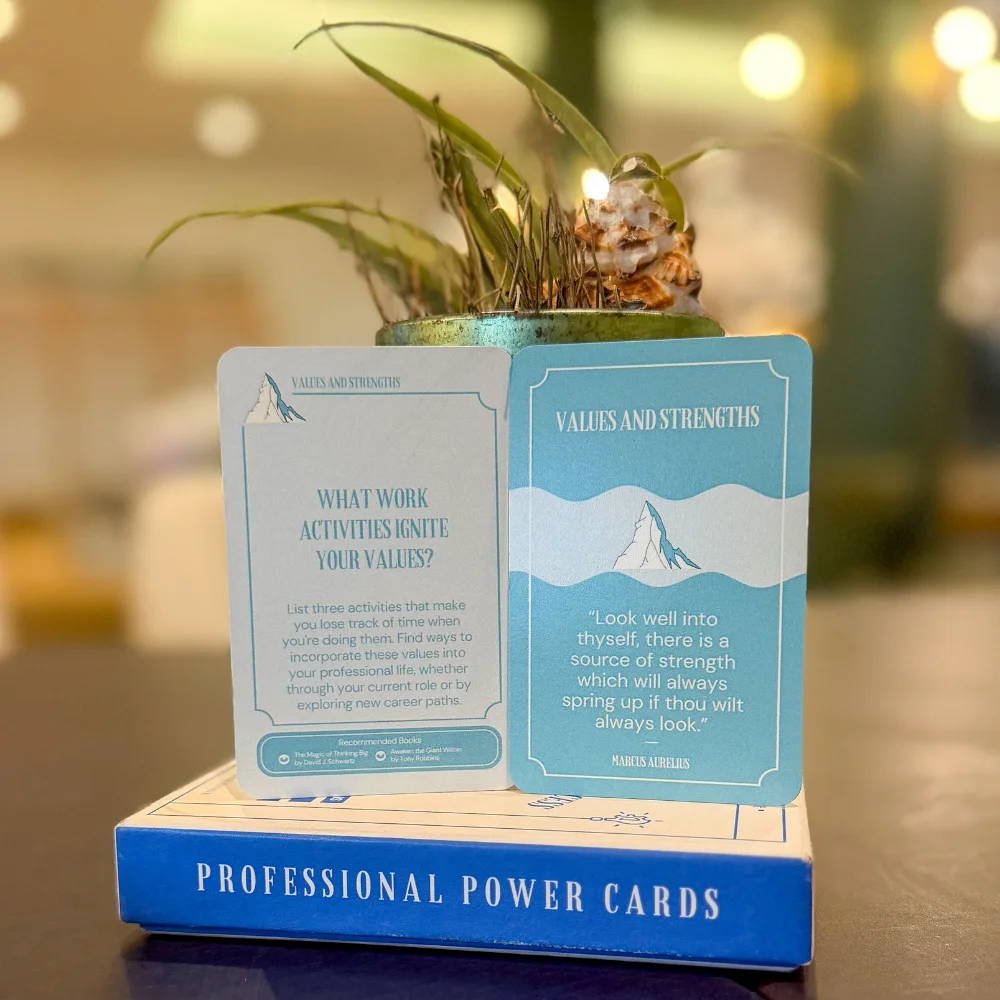
I also encourage my clients to create daily reminders of what they already bring to the table.
One tool I use for this is Power Cards. They help you reconnect with your strengths, achievements, and value instead of relying on outside validation.
An accountability partner can help too.
Choose someone who brings you back to your own goals and encourages action. Avoid turning those conversations into another place where you compare your progress with everyone else.
You do not need to become confident overnight and honestly, that’s not gonna happen.
You need to keep collecting small pieces of evidence that remind you what you are capable of.
Comparison Wastes Your Energy
A career transition already requires a lot of mental energy.
You need to research companies, build relationships, tailor applications, improve your LinkedIn profile, and think carefully about your next move.
Comparison takes energy away from all of this.
You spend an hour wondering why someone else found a job faster. You analyse their LinkedIn profile. You question whether you should change your CV again.
It can feel like you are thinking seriously about your career.
However, often, comparison is a distraction disguised as concern.
A useful question I encourage my clients to ask is simple:
Is this thought helping me decide what to do next?
If not, your energy is probably better spent somewhere else.
Comparison Makes You Less Authentic
Comparison can also make you copy what seems to be working for other people.
You see someone move into consulting, so you wonder whether you should do the same.
You notice how another professional describes themselves on LinkedIn, so you start using similar language.
You hear that someone found a job through a particular strategy, so suddenly that becomes your strategy too.
There is nothing wrong with learning from other people.
The problem begins when you stop asking whether their approach actually fits you.
I believe strong positioning starts with understanding what makes you different, not trying to look like everyone else.
Your experience, strengths, values, and ambitions create your professional story.
The more you imitate someone else’s, the less distinctive your own story becomes.
Comparison Stops Your Momentum
I see this one frequently with my clients.
They find an interesting job description.
They read it several times. They can see that much of their experience fits.
But they do not apply.
They tell themselves they need to improve something first. Perhaps the CV needs more work. Perhaps they need another qualification. Perhaps they should wait until they feel more confident.
Underneath that hesitation is often something much simpler.
They are afraid of being rejected.
Or they have looked at so many other professionals that they no longer feel good enough to put themselves forward.
So they keep looking at job descriptions without actually applying.
The same thing can happen with networking.
You research the person you want to contact, but never send the message.
Waiting until you feel completely ready can keep you waiting for a very long time.
Momentum comes from action, not perfection.

You can adjust after you act.
You cannot learn much from an application you never send or a conversation you never start.
Comparison Distorts Your Perspective
Comparison has a strange way of making your achievements disappear.
You focus on the language you do not speak fluently instead of the languages you already speak.
You focus on the Swiss network you do not have instead of the professional relationships you built throughout your career.
You focus on the job you have not found instead of everything you have learned since arriving.
I often encourage clients to look backwards for a moment.
Not to stay in the past, but to recognise how far they have already come.
Think about where you were six months ago.
What do you understand now that you did not understand then?
Who have you met?
What have you learned about yourself?
Progress can be difficult to see when you are constantly measuring it against someone else’s achievements.
Comparison Makes You Hesitate to Network and Apply
Comparison becomes especially damaging when it changes your behaviour.
You may start telling yourself that you are not experienced enough, connected enough, confident enough, or ready enough.
So, you hold back.
You do not contact the person you wanted to meet.
You do not apply for the role.
You do not share your perspective on LinkedIn because you assume other people know more.
Then, something predictable happens.
Because you take fewer actions, you create fewer opportunities.
Fewer opportunities reinforce the feeling that you are falling behind.
And that makes you hesitate even more.
It can become a cycle.
You do not need to feel completely confident before you break it.
Sometimes, one small action is enough to start.
The good news is that comparison does not have to remain your default response.
You can learn to notice it, question it, and redirect your attention towards something more useful.
Next, I want to show you practical ways to do exactly that as you build your career in Switzerland.
7 Ways to Break the Comparison Trap
You probably cannot stop comparing yourself to other people completely.
And you do not need to.
Comparison can sometimes give you useful information. Someone else’s career may inspire an idea or show you a possibility you had not considered.
The goal is to become more conscious of what happens next.
Do you use the comparison to learn, or do you use it as evidence that you are behind?
I encourage my clients to notice that difference.
When comparison starts affecting your confidence or stopping you from taking action, these seven strategies can help.
First, understand what you are actually comparing. You often know very little about the full story behind someone else’s success.
Second, be intentional about social media. LinkedIn can trigger comparison, but Facebook groups can be even more difficult during a career transition. Other people’s frustration, advice, and opinions can quickly influence how you see your own situation.
Third, define your own measures of success. A productive week does not have to end with a job offer. It might mean three useful conversations, one strong application, or finally getting clear about your direction.
Fourth, look at your own progress. Compare where you are today with where you were three or six months ago.
Fifth, build visibility in Switzerland. The more relationships and recognition you create locally, the less invisible you begin to feel.
Sixth, replace judgement with curiosity. Instead of asking why someone is ahead of you, ask what you can learn from what they did.
Finally, practise gratitude. Remember the experience, skills, relationships, and resilience you already bring with you.
These strategies are not about pretending that comparison never happens.
They are about catching it before it takes over.
You can notice the comparison, understand what triggered it, and choose a more useful response.
Let us look at each of these seven strategies in more detail.
Understand What You Are Actually Comparing
When comparison shows up, look closely at what you are actually comparing.
You may be comparing your difficult week with someone else’s job announcement.
You see their new title. You do not see the months of uncertainty that came before it.
You know every unanswered application, awkward conversation, and doubt in your own journey. You know almost none of theirs.
In other words, you are comparing your invisible effort with their visible achievement.
That comparison is incomplete from the beginning.
When you notice yourself doing this, ask yourself what you actually know about the other person’s journey.
Usually, the answer is much less than you think.
Limit Social Media Consumption
LinkedIn can be a powerful tool when you are looking for work.
You can research companies, connect with people, learn about opportunities, and build your professional visibility.
But that does not mean you need to consume everything you see there.
Use LinkedIn with a purpose. Go there to contact three people, research a company, or publish something useful. Then leave.
I would be even more careful with Facebook groups.
Expat groups can be helpful, but they can also become very negative. One person shares a difficult experience, and twenty others confirm that Switzerland is impossible.
Before long, you start carrying their frustration into your own job search.
Permit yourself to step away.
Protecting your attention is not avoiding reality. It is choosing which information deserves your energy.
Define Your Own Success Metrics

What does a successful week look like for you right now?
Not for your former colleague.
Not for the expat who says they found a job within six weeks.
For you.
Perhaps success this week means having three meaningful professional conversations.
Maybe it means sending two strong applications instead of twenty rushed ones.
It could mean improving your CV, contacting someone you have been afraid to approach, or finally becoming clearer about the kind of role you want.
A job offer is the final result of many smaller actions.
If that is the only result you count, you can spend months feeling as though you are making no progress.
Create measures you can influence.
That gives you something much healthier to focus on than someone else’s timeline.
Focus on Your Own Progress
If you need to compare, change the reference point.
Compare yourself with who you were six months ago.
What do you understand about the Swiss market now?
Who have you met?
What have you tried?
What have you stopped doing because you realised it was not working?
What has become clearer?
Career transitions rarely move in a straight line.
Sometimes you make progress without seeing an immediate result. A conversation may lead nowhere today but become useful three months later.
Look backwards occasionally.
You may discover that you have travelled much further than it feels.
Build Local Visibility
One of the best ways to reduce comparison is to become less invisible yourself.
Start showing up.
Have conversations. Attend relevant events. Join professional communities. Share your expertise. Help someone. Contribute to discussions where your experience is useful.
You do not need to become the loudest person in the room.
You need the right people to gradually understand who you are and what you can bring.
I have seen how this changes the way my clients experience their job search.
Instead of constantly asking how they compare with other professionals, they begin noticing their own impact.
Someone remembers them.
A contact makes an introduction.
A conversation leads to another conversation.
Those are signs that local visibility is growing, even before a job offer arrives.
Get Curious Instead of Judgemental
Someone else’s success can either become a reason to criticise yourself or a source of information.
Try choosing the second.
When you notice a comparison appearing, ask yourself what you can learn from that person’s journey.
Perhaps they built relationships in a professional association.
Maybe they became more visible around one specific area of expertise.
Perhaps they approached smaller companies instead of only applying to large organisations.
The question changes from wondering why they are ahead of you to asking what you might try differently.
That small shift matters.
Curiosity gives you options.
Judgement usually gives you another reason to feel bad.
Practice Gratitude
Comparison directs your attention towards what is missing.
Gratitude brings some balance back.
Think about what you already have.

Years of experience. Skills you developed through difficult situations. People who trust you. Problems you know how to solve. The courage to build a life and career in another country.
You can also recognise the smaller steps: The first networking conversation that felt easier. The application you finally sent. The person who replied to your message. The clearer understanding of what you want next.
Gratitude does not mean pretending that everything is easy.
It does not mean ignoring rejection, uncertainty, or financial pressure.
It simply reminds you that you are not starting from zero.
Breaking free from comparison becomes easier when you remember that you are not behind.
You are building your own path, under your own circumstances, on your own timeline.
Your Career Doesn’t Have to Follow Someone Else’s Timeline
There is no universal timeline for building a career in Switzerland.
Your circumstances are different. Your priorities are different. And what you want from your career may be very different from what someone else wants.
I often remind my clients that the goal is not to catch up with another person.
The goal is to build a career that fits your own values, your priorities, and your life.
Your Circumstances Are Different
Moving to another country is not a small career change.
You may be learning a language, rebuilding your network, understanding a new culture, raising a family, or adjusting to a completely different professional environment.
Someone you compare yourself with may not have any of these challenges.
Even two expats living in Switzerland can have very different starting points.
One person may speak the local language. Another may already have contacts here. Someone may work in an industry where English is common, while another person needs German or French to access most opportunities.
So why should their timelines be the same?
I encourage you to look at your circumstances before deciding that you are moving too slowly.
A different starting point naturally creates a different journey.

Your Priorities Are Different
Your priorities can also change over time.
What felt important ten years ago may not be what matters to you today.
Perhaps you once wanted the biggest title possible.
Now you may want more flexibility.
You may want meaningful work, more time with your family, less pressure, or the freedom to build something of your own.
I see this often with experienced professionals.
At some point, career success becomes less about climbing as quickly as possible and more about making intentional choices.
That can mean accepting a smaller company, changing direction, working fewer hours, or choosing a role that looks less impressive on LinkedIn but fits your life much better.
None of these choices mean you are falling behind.
They may mean you finally know what you are moving towards.
Your Definition of Success Is Different
Success is personal.
For one person, it may mean becoming a senior executive.
For another, it may mean finding meaningful work in Switzerland while having enough time for family.
Someone else may want to become an expert, start a business, change industries, or simply enjoy going to work again.
None of these goals is more valid than another.
This is why comparison becomes less useful once you become clear about what you actually want.
You may discover that the person you have been trying to catch is heading towards a destination you do not even want.
You do not need someone else’s career to prove that yours is going well.
You need a direction that makes sense for you.
The real question is not whether you are behind.
The real question is whether you are building something that matters to you.
Conclusion: You May Not Be Behind. You May Just Be Starting Somewhere New.
Moving to Switzerland can make an accomplished professional feel like a beginner again. But starting again in a new market does not mean starting from zero.
You bring your experience with you.
You bring the difficult decisions you have made, the problems you have solved, the relationships you have built, and the lessons you have learned throughout your career.
What you may not have yet is local recognition of that experience.
And that can be rebuilt.
I have seen professionals arrive in Switzerland and question abilities they never questioned before. Often, they do not need to become more qualified. They need clarity about where they are going, confidence in what they already bring, and a strategy for making that value visible here.
Comparison will probably still appear from time to time.
The goal is not to eliminate it. Notice it, question what you are actually comparing, and bring your attention back to your own path.
Because someone else’s timeline cannot tell you whether you are making the right choices for your life.
If comparison has left you questioning your direction or wondering what your next move should be, you do not have to figure everything out alone.
I invite you to book a strategy call with me.

We can look at where you are now, what you want next, and what may be keeping you stuck.
Sometimes, seeing your situation from a different perspective is the first step towards moving forward again.
Frequently Asked Questions About the Comparison Trap
These are some of the questions I often hear from expats who feel they are falling behind professionally after moving to Switzerland.
Why do expats in Switzerland compare themselves to others?
Relocation changes more than where you live. You may lose the professional context, reputation, and network that took you years to build.
When you are unsure where you stand in a new market, it is natural to look at other people for reference.
The problem is that you often compare your entire transition with only the visible parts of someone else’s journey.
How does comparison affect career transitions?
Constant comparison can slowly drain your confidence and energy.
It can make you question your experience, hesitate to apply for roles, or avoid networking because you do not feel ready or good enough.
It can also distort your perspective. Instead of noticing your own progress, you focus on what other people have achieved.
Is it normal to feel behind when moving to Switzerland?
Yes, it is very common.
You are rebuilding professional relationships, visibility, and credibility from a different starting point. That takes time.
Feeling behind does not necessarily mean you are behind.
It may simply mean you are in transition.
How can I stop comparing myself to others?
Start by becoming more intentional about what gets your attention.
Limit social media when it leaves you discouraged. Define your own measures of success. Look at how far you have come instead of constantly looking at where others are.
Build relationships and visibility in Switzerland. When someone else’s success triggers comparison, get curious about what you can learn instead of using their progress to judge yourself.
And remember what you already bring with you.
You are not starting from zero.
What if I cannot stop comparing myself to others?
If comparison is affecting your confidence or stopping you from taking action, it may help to get an outside perspective.
This is something I often work on with my clients. We look at what is actually happening, separate facts from fears, and identify the next steps that make sense for their situation.
A career coach cannot remove uncertainty from a career transition.
However, the right support can help you regain clarity, recognise your value, and move forward with a stronger sense of direction and strategy.