
Before moving to Switzerland, your career probably had a familiar shape.
You knew your role, your industry, the people around you, and what your next professional step might look like.
Then, your partner received an opportunity in Switzerland, and a new possibility opened up for your family. You discussed it together, weighed what the move could bring, and decided to take that step.

There may have been excitement in that decision. A new country, a new chapter, and new opportunities for your family.
At the same time, the move did not affect both careers in exactly the same way.
Your partner may have arrived with a role already waiting, along with colleagues, routines, and an immediate connection to professional life in Switzerland. For you, the path may have been less defined.
I have seen this with many professionals who moved to Switzerland for their partner’s career. They supported the decision and genuinely wanted the move to work.
However, choosing something does not mean you cannot struggle with what it costs you.
You are allowed to miss the career you left behind. You are allowed to slow down, pause, rethink things, and take time to understand what you want next.
In fact, from what I observe, trying to rush this stage often makes the process even more challenging.
You do not always need another job immediately. Sometimes, you first need clarity about what kind of work still makes sense for you, your family, and the life you are building here.
This is also why I do not see this simply as a career gap.
It is a relocation with career consequences.
That distinction matters because the solution is not just updating your CV and sending more applications. You may need to rebuild your professional identity, understand a new job market, create a new network, learn a local language, and decide what you actually want now.
You should not have to figure all of that out alone.
Supporting your partner’s career does not mean abandoning yours. It means yours needs a different plan and the right support.
This is why I believe partner support / spouse coaching and intercultural training should be part of more relocation packages. Some companies already provide this type of support, but many relocating partners are still left to navigate the professional side of the move largely on their own.
In this article, I want to look at both sides.
The emotional reality of what changes when your career is interrupted by relocation, and the practical steps that can help you build your way forward in Switzerland.
Before anything practical can help, it is worth understanding what actually changed. Not the country, but the conditions your career depended on.

TL;DR — Key Takeaways
You moved to Switzerland for your partner’s career. Yours did not come with the same setup.
Supporting your partner’s career does not mean abandoning yours. It means yours needs a different plan.
- You have not lost your value. You are rebuilding the local recognition of that value.
- It is a relocation with career consequences, not simply a career gap.
- Your permit, language, local network and CV story can all change your strategy and timeline.
- Start with what you want now, not only what you had before.
- Your partner’s career is not a fair benchmark. You started from a different position.
You did not stop being a professional when you boarded that plane. You just changed the environment you are practising in.
What Happened to Your Professional Identity
When you move countries, you do not only leave a job behind.
You also leave the environment that helped you understand who you were professionally.
People knew your work. Former colleagues could recommend you. Your education and past employers meant something without much explanation.
Then, you arrive somewhere new, and much of that recognition disappears.
I experienced a version of this myself.
I grew up in both Romania and Greece, where the atmosphere and social rhythm felt very different to me. My partner (now husband), Adrian, had already been working in Switzerland for a year. When I decided to join him and arrived in Switzerland, I found the adjustment difficult even if I did my research on intercultural studies and knew the theory “by heart”.
The weather felt colder. People seemed quieter and more reserved.

I did not have an established circle of friends around me. The only Swiss friend I had in the beginning was the one I knew many years before moving here.
Nothing was necessarily wrong. It was simply unfamiliar.
And professionally, unfamiliarity can be even harder.
You Lost the Context, Not the Competence
One thing I see often is that people start questioning themselves after relocation.
A role that once felt obvious suddenly feels difficult to explain. A qualification that carried weight at home may need more context here. A strong professional network may no longer be nearby.
It can start to feel as though something has changed in you.
Usually, that is not what happened.
Your knowledge did not disappear when you crossed the border. Your experience did not reset. The projects you managed, the problems you solved, and the skills you developed are still yours.
What changed was the context around them.
You have not lost your value. You have lost the local recognition of that value.
That is a very different problem, and fortunately, it is one you can work on.
Why the Move Felt Joint, but the Career Cost Was Not
A relocation can be a genuine family decision.
You may have discussed it together, agreed that it was the right move, and felt excited about the opportunity.
Yet, the professional starting points can still be very different.
Your partner may arrive with a contract, a team, colleagues, meetings, and an immediate place in the local professional world.
You may arrive without any of those things.
From what I observe, this difference is often underestimated.
One person starts building professional history in Switzerland from the first working day. The other first has to understand the market, rebuild contacts, work on language skills, and decide what their own next step should be.
That does not mean the original decision was wrong.
It simply means the professional cost of the decision was not distributed equally.
The Guilt of Feeling Resentful
This is where things can become complicated.
You can be genuinely proud of your partner and still miss what you had.
You can be happy that the move created new opportunities for your family, while also feeling frustrated that your own career has slowed down.
Those feelings can exist at the same time.

I think this is important to say because many people immediately judge themselves for feeling frustrated.
They think they should simply be grateful.
Yet, understanding what you gave up does not mean you regret your family decision.
It means your career mattered to you too.
Losing a Career Without Losing Your Ambition
A pause can sometimes look like a loss of ambition from the outside.
It does not have to be.
You may be taking language classes. Looking after children. Learning how Switzerland works. Rebuilding a network. Questioning whether you even want the same career you had before.
That period can feel slow because there may be very little visible progress.
However, I often see something else happening underneath.
People start becoming much clearer about what they want next.
Some want to return to a similar role. Others realise they want more flexibility. Some decide to change direction completely.
The important part is not recreating your previous professional life as quickly as possible.
It is understanding which parts of that identity still belong in the next one.
You are still the same experienced professional.
Now, you need to make that experience visible and relevant in a new environment.
The identity shift is one layer. Switzerland adds several more, and some of them are specific to this country in ways that are rarely explained.
The Practical Realities That Make It Harder in Switzerland
Once you understand the identity shift, there is another part of the story.
Switzerland has its own labour market, rules, languages, expectations, and hiring culture.
When I work with people who have recently moved here, I often see the same surprise.
They expected finding another job to take a few months. Instead, they discover several smaller barriers that all need to be worked through.
You are not starting from zero.
You are starting from a position where the rules are different, and nobody has explained them.
You can find more insights on rebuilding your professional identity from this article: Starting a New Professional Chapter in Switzerland Without Starting From Zero
Work Permits and What Your Spouse’s Status May Mean for Your Right to Work
Before building a job search strategy, understand exactly what your permit allows you to do.
Do not rely on what happened to another expat family.
Your situation can depend on your nationality, your permit, your partner’s status, and how you entered Switzerland.

For example, spouses and children of EU and EFTA nationals admitted through family reunification generally have the right to work in Switzerland. Different rules can apply in other situations. Family members of some non-EU and EFTA short stay permit holders may need additional authorisation.
This is why I always recommend checking your own situation with the relevant cantonal authority.
Do this before planning the next six months around a particular career path.
Your permit is not a small administrative detail.
It can influence which options make sense and how quickly you can pursue them.
The Gap That Was Not Your Choice
Then, there is the career gap.
You may know exactly why it happened.
You moved countries. You supported your family. You settled children into school. You learned a language. You rebuilt your life.
However, your CV does not explain any of that unless you tell the story.
This is something we work on with our clients very carefully.
We do not try to hide the transition.
We help them communicate what happened in a way that shows movement and development rather than an empty period.
Maybe you completed a qualification, improved your French or German. You could have volunteered, explored a new direction, built new contacts, or finally had space to reconsider what you wanted from your career.
All of that can become part of the story.
The goal is not to make the gap disappear.
The goal is to give it context and show what came from it.
Learning the Language Without a Workplace to Learn It In
Language is another challenge I see regularly.
It is one thing to attend French or German classes.
It is another thing to use the language every day with colleagues, clients, and people around you.
Your partner may have that environment automatically through work.
You may not.
That can make language progress feel frustratingly slow, even when you are studying consistently.
This is why I think language learning needs to become part of your life, not only part of a course.
Conversation groups, volunteering, local activities, professional events, and regular contact with people in your region can all help.
You do not need perfect French or German before you start building a professional life, but you do need opportunities to use what you are learning.
No Local Network and No Local References
You may have had a strong network before the move.
The problem is that most of those people are somewhere else.
In Switzerland, you are entering a market where few people know you yet.
That can affect much more than access to job openings.
You may not have someone locally who can recommend you. You may not know how companies in your field recruit. You may not know which employers are open to international profiles.
This is why I often tell clients that networking is not an extra activity around the job search.
It is part of the job search.
Start with conversations.
Talk to people in your industry. Join relevant professional communities. Reconnect with former colleagues who may know someone here.
Do not enter every conversation asking for a job.
At first, you are learning how your profession works in Switzerland and helping people understand who you are.
That local recognition takes time to build.
When Your CV Needs Translating, Not Just Updating
Another mistake I see is taking the old CV and simply updating the address.
The experience may be excellent, but the reader in Switzerland still needs to understand it.
A company that everyone knew in your previous country may mean nothing to a recruiter here.
The same can happen with job titles, qualifications, professional bodies, and even the size of the projects you worked on.
Sometimes your experience needs explanation, not because it is less valuable, but because the context is missing.
For some regulated professions, there is also a formal recognition process for foreign qualifications. Whether recognition is required depends on the profession and the qualification.
So, instead of asking only whether your CV looks good, ask a different question.
Will someone in Switzerland understand why this experience matters?
That is a much more useful test.
None of these obstacles are permanent.
But they do change the strategy and, very often, the timeline.
I think this is one of the most important expectations to set when you relocate.
Do not assume that you will arrive in Switzerland and start working immediately.
It can happen.
However, in my experience, several factors are usually involved, including your profession, language level, permit situation, seniority, local demand, network, family commitments (especially if moving with kids), and how clearly your experience translates to the Swiss market.
Your partner arrived with a job already waiting.
You arrived with a professional life to rebuild.
Those are two very different starting points, and they deserve two different timelines.
The good news is that once you understand what you are dealing with, you can stop treating the process as one big job search problem.
You can start working through it one piece at a time.
How to Rebuild Your Career in Switzerland
Once you understand what has changed, you can start rebuilding with much more intention.
I wouldn’t start with job applications.
I would begin with clarity.
From what I see in my work, many people arrive in Switzerland and immediately try to recreate their previous career.
Sometimes that works.
Sometimes relocation creates an opportunity to ask questions you simply did not have time to ask before:
- What do I actually want now?
- What kind of work fits my life today?
- What do I want to keep from my previous career, and what am I ready to leave behind?
You do not need to rebuild your old career here.
You need to build one that fits the life you actually have now.

Start With What You Want Now, Not What You Had Before
Your previous job is an obvious starting point.
It should not automatically become the destination.
I have worked with experienced professionals who initially believed they needed another role at the same level.
Once we started looking deeper, they realised that the title was not actually what they missed.
They missed solving complex problems.
Or working with people.
Or having independence.
Or feeling useful.
That distinction can completely change the direction of a career search.
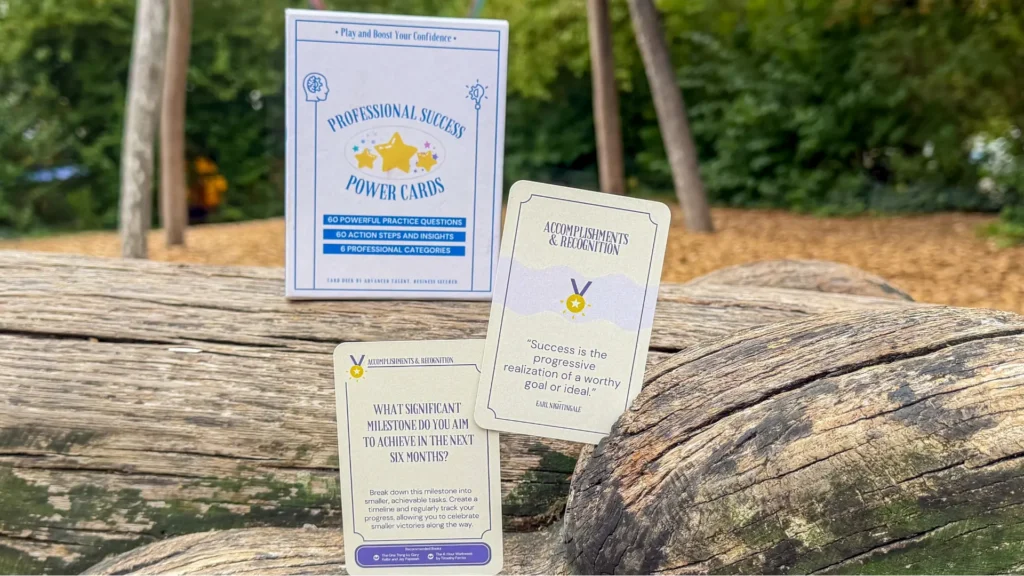
This is one reason I use our Professional Succes Power Cards in my coaching. The questions and action steps related to Values and Strengths, Confidence and Goals are to help you find the thread that has followed you through your career.
- What are you naturally good at?
- What matters to you now?
- What gives you energy?
- What kind of environment helps you do your best work?
- And what do you want your life in Switzerland to make possible?
Someone who previously held a senior role may discover that a smaller company, a more flexible position, or a different type of responsibility suits them better now.
That is not necessarily a step backwards.
It may simply be a better fit.
Know Your Permit Before You Plan Anything
Before building a strategy, understand what you are legally able to do.
Do not make assumptions based on another family you know.
Work rights can depend on your nationality, your permit, and the status under which you joined your partner.
For example, spouses admitted through family reunification with an EU or EFTA national generally have access to the Swiss labour market. Different conditions can apply in other situations, particularly with some short-term permits.
Check your own case with the relevant cantonal authority.
I would do this early.
You do not want to spend months building a strategy around an option and only later discover that additional authorisation is required.
Your permit does not decide your career.
Yet, it does help define which routes are available to you right now.
How to Present a Relocation Gap on a Swiss CV
A relocation period should not simply disappear from your CV.
And I would avoid writing only: 2022 to 2024, Career break
That tells the recruiter very little.
Instead, give the period context.
For example,
2022 to 2024, Relocated to Switzerland for family reasons. Used this period to strengthen French, complete professional training and define the next direction of my career.
Of course, this should reflect what you actually did.
The objective is not to disguise the gap.
It is to explain the transition.
This is also something I work on with clients beyond the CV.
You need to be comfortable talking about this period in an interview.
If you sound apologetic about it, the interviewer may also start seeing it as a weakness.
Instead, know your story.
Explain why you moved, what happened during the transition and what you are ready to do now.
Then bring the conversation forward.
Your CV should not only explain where you have been.
It should make your next direction clear.

Rebuilding Language Without a Workplace
One of the hardest parts of language learning after relocation is the lack of daily practice.
Your partner may be hearing French, German or Italian every day at work.
You may have a two-hour class twice a week.
Those are very different learning environments.
This is why I recommend creating your own structure: Take a course with a regular schedule, find a tandem partner, join a conversation group, volunteer somewhere where the local language is used.
Choose activities where you need to speak rather than only listen. Even small interactions count.
The goal is regular exposure and the confidence to use what you already know.
And give yourself time.
Learning a language without a workplace around you can be slower, but that does not mean you are doing it badly.
It means you need to create the environment that your partner may already have automatically.
Building a Network From a Standing Start
When people hear networking, they often think they need to attend as many events as possible.
I do not think that is the most useful approach.
I would start much closer to home.
First, look at who you already know.
Former colleagues may know people in Switzerland.
Your university may have alumni here.
Your professional association may have a Swiss chapter.
A former manager may be able to introduce you to someone in your industry.
Then choose one or two relevant professional communities and actually participate.
Do not join ten groups and disappear.
Try to have meaningful conversations.
Ask people how your industry works here, how they entered the market, and what they see changing.
At this stage, you are not asking everyone for a job.
You are learning, then follow up.
This is the step people often forget.
A useful conversation today may lead to an introduction three months from now.
Professional relationships become valuable through consistency.
And finally, let people discover what you know.
Comment thoughtfully.
Share an experience.
Help someone when you can.
Ask good questions.
You do not need to constantly promote yourself.
You need to become known.
I have written much more about this in my guide on building a professional network in Switzerland, because networking here deserves its own strategy.

Consider the Intermediate Options
Getting another permanent role is not the only sign that your career is moving forward.
Sometimes an intermediate step is exactly what creates the next opportunity.
Part-time work can make sense if you are studying, managing family responsibilities, or want a gradual return to work.
From what I observe, many professional part-time opportunities are closer to 80 percent. Roles at 60 percent or below can be harder to find in some fields.
Contract or project work can be useful when you want to build local experience and Swiss references without immediately committing to a permanent position.
Volunteering can also be surprisingly valuable. It gives you local experience, helps you practise the language, and exposes you to Swiss working and communication styles.
Most importantly, you are contributing something while meeting people naturally.
Further study can make sense when you are genuinely changing direction or when your profession requires recognition or additional qualifications.
Do not study simply because you do not know what else to do.
First check whether another qualification is actually needed.
Switzerland requires formal recognition for certain regulated professions, while other professions do not require the same process.
Independent consulting may also be an option if you already have expertise and clients or contacts elsewhere.
However, check the legal and permit requirements before choosing this route.
The right answer depends on your individual situation.
I would add another option that people sometimes overlook: Intercultural career coaching or spouse / partner support career coaching.
You are not only trying to find a job.
You are learning how another professional culture communicates, recruits, networks and makes decisions.
Understanding those differences can save a lot of unnecessary trial and error.
The point is not to find the best intermediate option.
There is no universal best option.
Choose the one that fits your family, permit, finances, and longer-term direction.

Give Yourself a Realistic Timeline
This may be one of the hardest parts.
Your partner started working soon after arriving because the job was often the reason for the relocation.
You arrived under completely different conditions.
So why would the timelines be the same?
I also see people comparing themselves with other expats.
Someone arrived six months ago and already has a job.
Someone else found one after three applications.
Another person seems to have built an incredible network almost immediately.
You rarely know the whole story. They may work in a different industry, or already speak the local language.
I have written about this separately in my article on the comparison trap for expats in Switzerland because I see how easily comparison can undermine an otherwise sensible career strategy.
Your timeline needs to reflect your circumstances.
Instead of measuring only whether you have received a job offer, look at the smaller signs of progress.
You understand your target market better.
Your CV tells a clearer story.
You can explain your transition confidently.
You have started speaking to people in your industry.
Together, they are how a new professional life starts to take shape.
And this is why I think it is important to decide what progress means for you before you start measuring yourself against anyone else.
Because comparison usually begins when we only look at the visible outcome.
What we do not see are the different starting points, circumstances and timelines behind those outcomes.
Once you begin looking at your own progress more closely, it becomes easier to see why comparison can be so misleading. That brings us to something I see very often with people rebuilding their careers after relocation.
The tendency to use someone else’s career as the benchmark for their own.
Why Your Partner’s Career Is not a Useful Benchmark
Once you start defining your own signs of progress, one thing becomes much clearer.
Your partner’s career is not a useful benchmark for yours.
Not because you should avoid comparison altogether, but because the starting conditions are completely different.
The Structural Reason the Comparison Fails
Your partner arrived with something already in place: A role, a team, and a professional network that started forming from day one.
Often, they also have a workplace where they hear the local language, learn how people communicate, and understand how business is done here.
You may be building all of that from scratch.
From what I observe, this difference is easy to underestimate because both people moved to Switzerland at the same time.
Yet, professionally, you did not arrive at the same starting line.
You are not behind your partner.
You are on a different timeline, in a different market, starting from a different position.
What to Measure Instead
I encourage clients to measure progress against things they can actually influence:
- Are you clearer about the roles you want?
- Can you explain your experience more confidently?
- Is your CV better positioned for the Swiss market?
- Are you having more conversations with people in your field?
- Is your French or German improving?
- Are you getting closer to interviews?
These are much more useful markers than comparing job titles or salaries inside your household.
Why Slower Progress Is Not the Same as Failure
Career rebuilding after relocation often happens in stages.
First, comes clarity.
Then, positioning.
Then, visibility.
Then, relationships.
Then, opportunities.
Not everyone moves through those stages at the same speed.
Your partner’s timeline reflects the conditions they arrived with.
Yours reflects yours.
I think the more useful question is not whether you are moving as fast as someone else.
It is whether the steps you are taking are moving you in the right direction.
That is a much fairer way to judge progress.
Your Career Did Not End Here
Moving to Switzerland may have interrupted your career.
It did not erase it.
You gave up a professional context that once made your experience easy to understand. You left behind people who knew your work, systems you understood, and a market where your background already had meaning.
That is a real change.
And rebuilding starts with being honest about it.
You may need time to understand the market, strengthen the language, rebuild your network, explain your experience differently, and get clear about what you want now.
That process often takes longer than people expect.
From what I see, this is where many people become unnecessarily hard on themselves.
They assume that if the process is slow, something must be wrong.
Usually, it simply means that several pieces need to come together.
You did not stop being a professional when you boarded that plane.
You just changed the environment you are practising in.
The work now is to make all of that visible, relevant, and connected to the life you are building in Switzerland.
If you are in this stage right now and trying to work out what comes next, I am always happy to have a strategy call with you.

Sometimes the first useful step is simply getting clear on where you are, what has changed, and what kind of career would make sense from here.
Frequently Asked Questions
Can I work in Switzerland on my spouse’s permit?
It depends on your nationality, permit type, and how you joined your spouse in Switzerland.
For example, spouses admitted through family reunification with an EU or EFTA national generally have the right to work. Different conditions can apply in other situations.
Do not assume that another expat family’s situation applies to you. Check your specific case with your cantonal migration or labour authority before making career plans.
Will a career gap hurt my chances with Swiss employers?
It can create questions if it is left completely unexplained.
A relocation period is different from simply disappearing from the workforce. Give it context and show what happened during that time.
You may have relocated your family, studied, improved your language skills, volunteered, completed training, or reconsidered your professional direction.
The goal is not to hide the gap. It is to help the employer understand it.
How do I explain a relocation on my CV?
Keep it brief and factual.
For example, you could write that you relocated to Switzerland for family reasons and used the period to improve your language skills, complete training, or define your next career direction.
Then move the focus forward.
When I work on this with clients, we also practise how they explain the transition in an interview. Your CV and your spoken story should support each other.
How do I build a professional network in Switzerland without a job?
Start with the connections you already have.
Look at former colleagues, alumni networks, professional associations, industry communities, LinkedIn contacts, and people who may know someone in Switzerland.
Then start having conversations.
From what I observe, networking works much better when you approach people with curiosity rather than immediately asking for a job.
Volunteering and professional events can also help you build relationships while becoming more familiar with the local environment.
Should I learn German or French?
Start with the language that matters most where you live and where you want to work.
French will usually be more relevant in Romandie. German is generally more useful in German speaking Switzerland.
Your industry matters too.
Some international companies operate largely in English, while other roles require regular communication with local customers, colleagues, or authorities.
You do not always need to wait until your language is perfect before starting your job search. However, improving the local language can give you more options over time.
Is it worth retraining after moving to Switzerland?
Sometimes, but I would not automatically start another degree or certification because your job search is difficult.
First, find out what is actually missing.
Your qualification may need formal recognition. Your experience may need better positioning. You may need stronger language skills or more local connections.
Further study makes the most sense when it solves a specific problem or supports a direction you genuinely want to pursue.
Can a career coach help me rebuild my career in Switzerland?
Career coaching can be particularly useful when you know you want to work again, but are no longer sure what the right next step looks like.
In my work, I often see that the first challenge is not the CV.
It is clarity.
We look at what the person wants now, how their previous experience translates into the Swiss market, how to communicate the relocation period, how to position themselves with confidence to create alignment, and what strategy fits their situation.
A coach cannot make the market move faster nor directly introduce you to companies!
Yet, the right support can help you understand where to focus your energy to achieve your goals and avoid spending months following a strategy that does not fit your circumstances.