

The more senior you become, the fewer roles you will find online, and this is one of the hardest truths to accept during an executive job search in Switzerland.
At the mid-level, opportunities are visible and structured. At the executive level, hiring becomes quieter and far more selective, shifting into the hidden job market in Switzerland. Many roles are filled through referrals or internal moves before they are ever posted, which means relying only on job boards quickly becomes limiting.
At the same time, another barrier appears.
Unless you know how to bypass the ATS, Applicant Tracking Systems act as invisible gatekeepers. These systems are designed to filter candidates based on precise matches, looking for exact job titles, keywords, and familiar career paths. They are built to reward repetition of the past.
But executive leadership is not about repeating yesterday.
It is about solving new problems, leading transformation, and driving future growth. This creates a clear mismatch between how systems evaluate candidates and how senior professionals actually create value.
In my over – a – decade work with senior professionals across Switzerland, I see two groups repeatedly affected by this.
The first is the senior expats, with a strong international track record but no local network, relying heavily on online applications that lead to little or no response.
The second is the laid-off senior locals (Swiss citizens or long-term residents), with years of experience and a solid reputation, but unfamiliar with how digital recruitment and ATS filters now shape the hiring process.
Different profiles, same frustration.
Both are trying to enter through a system that was never designed for them.
If you recognize yourself in one of these situations, it is worth reading on, because I will walk you through a few practical approaches that can help you navigate this market more effectively.
TL;DR: The Executive Summary
- The Swiss iceberg effect: The vast majority of senior roles belong to the hidden job market in Switzerland. If you are only applying through online portals, you are competing for a tiny fraction of the actual opportunities available.
- Algorithms penalize leadership: During an executive job search in Switzerland, Applicant Tracking Systems act as invisible gatekeepers. They often reject highly qualified leaders because the software only measures precise past matches, completely missing your future strategic value.
- Peer-to-peer positioning: To successfully bypass the ATS, you must stop acting like a standard candidate. Whether you are mastering expat networking in Switzerland from scratch or activating a dormant local network, success requires connecting directly with human decision-makers.
- Format for the bot, write for the board: Networking gets you the meeting, but your CV still has to pass HR compliance. You must balance rigid ATS formatting with bullet points that prove your future ROI to the CEO.
Why the Swiss Job Market is Hidden for Executives

Most senior professionals approach the job market as if everything was visible online, but in Switzerland, this is only a small part of the reality.
A useful way to understand this is through what I called “The iceberg metaphor”.
What you see on job boards and company websites is just the tip. It represents a small fraction of available opportunities. According to University of Zürich and research from Christian Gschwendt in 2022, the majority of senior roles sit below the surface, filled through internal mobility, trusted referrals, and direct conversations between decision makers.
This means that when you rely only on online applications, you are not just competing with other candidates. You are also limiting yourself to the smallest and most competitive part of the market.
In simple terms, you are fighting the algorithm for visibility, while the real decisions are happening elsewhere.
The Expat Trap: High Value, Zero Local Network
Many senior expats arrive in Switzerland with strong international careers and a clear sense of value.
On paper, they are excellent candidates.
They have led teams, delivered results, and worked in complex environments. Yet once they start applying, the response is often silence.
This is where the frustration begins.
Swiss employers place a high value on local market context. They want to see familiarity with the business environment, the culture, and often the language. When your experience comes from abroad, even if it is strong, it does not always translate clearly in the first screening step.
This becomes even more challenging with ATS systems.
These systems are designed to recognize patterns they already know. If your CV format differs from Swiss expectations, your profile may not pass the initial filter. This can happen even before a recruiter has the chance to review your experience.
Read my full guide on ATS and what it means to have an ATS-compatible CV.
The result is a difficult situation.
You bring high value, but you lack local visibility.
And without a network to bridge that gap, your applications remain unseen, regardless of how qualified you are.
The Laid Off Executive Trap: A Stale Network and Modern Algorithms

For many senior professionals in Switzerland, a job search begins after ten, fifteen, or even twenty years in the same company.
During that time, they built strong expertise, a solid reputation, a reliable network and loyalty to their company. But they have not needed to navigate the job market for a long time, and the rules have changed.
Today, recruitment is more digital and far more structured.
Applicant Tracking Systems (ATS) play a central role in filtering candidates, and these systems are far more rigid than many expect. They look for clear matches, precise wording, and familiar formats. If your CV does not align with these expectations, the CV reviewer cannot find the requested information.
This is where many experienced professionals get caught off guard.
Their CV often reflects how hiring worked years ago. It lists responsibilities rather than measurable results, and it may not include the keywords or structure that modern systems rely on. At the same time, while they do have a network, it is often inactive. Relationships that were once strong have not been maintained with career mobility in mind.
LinkedIn also becomes a missed opportunity.
Many senior professionals have the same profile for years without any updates. They are not visible, not engaging, and not positioning themselves in a way that attracts decision makers. If you’re job hunting, especially in markets like Switzerland where networking is key, being absent or inactive on LinkedIn quietly removes you from a large part of the opportunity pool.
Then there comes another difficulty: They have experience and credibility, but their tools and approach no longer match how hiring works today.
Furthermore, senior professionals often face age bias in Switzerland, adding another layer of difficulty to landing a role after being laid off. I recently wrote an article, ‘How to Overcome Age & Gender Bias in the Swiss Job Market,’ to offer an insider’s perspective on navigating these exact challenges.
The Precise Match Trap: Past Experience vs Future Value
This is often the part that feels the most frustrating, and also the most unfair.
Applicant Tracking Systems are built to look backward. They scan your past roles, your titles, and your keywords to find a close match with the job description. In simple terms, they try to confirm that you have already done the same job before.
But at a senior level, your value goes far beyond that.
You are not just a reflection of your past roles. You bring critical thinking, perspective, and the ability to lead in new and uncertain situations. You see patterns, make decisions, and guide teams through change. These are the qualities companies need, but they are also the hardest to capture in a system.
This is where another gap appears.
An algorithm cannot fully understand vision, adaptability, or growth potential. It cannot see how your experience in one context can transfer to another. Instead, it relies on clear and familiar signals, which often means it favors candidates whose profiles look almost identical to the role on paper.
If your career path is not perfectly linear, this can work against you.
Many strong leaders have built their careers across different industries, functions, or environments. That diversity is a strength in real life, but it can be misunderstood in a system that looks for consistency above all else.
If you have ever felt overlooked despite knowing you could do the role well, you are not alone.
Rest assured that in many cases, it is not about your ability. What needs to be taken into consideration is the way your experience is filtered and interpreted before it reaches the right person.
The Bypass Strategy: Reaching Human Decision Makers in Switzerland
If the front door is guarded by systems, then you need to use a different entrance.
At a senior level, this means moving away from application-driven strategies and toward what I call peer-to-peer positioning.
This is totally different from asking for a job.
It is about showing up as an equal in conversations with decision makers, including founders, board members, and senior leaders. Instead of trying to pass a filter, you position yourself as someone who understands the same challenges, speaks the same language, and can contribute at a strategic level.
In simple terms, you shift from being a candidate to being a peer.
This is how many senior roles are actually filled in Switzerland.
Through conversations, trust, and shared perspectives on real business problems, not through keywords in a system.
For Expats Building a Swiss Network from Scratch

If you are new to Switzerland, the instinct is often to apply to as many roles as possible.
Many of my clients said it feels productive, but in most cases, it leads to very little progress.
A more effective approach is to shift your focus from applications to connections.
Start by identifying the right people on LinkedIn. Not just recruiters, but decision makers in your field, such as department heads, directors, founders, or board members. These are the people who understand the real needs of the business and often influence hiring decisions long before a role is published.
The goal is not to ask them for a job.
Instead, approach them with curiosity and respect for their experience.
You can reach out with a short and thoughtful message, share your values, and cultural awareness. Ask for a brief conversation to better understand the industry, the challenges companies are facing, and how someone with your background can position themselves effectively.
This is often called an informational coffee chat.
However, there is an important nuance to keep in mind.
Senior professionals in Switzerland are often very busy, and they rarely make time to speak with someone they do not know. This means you need to build a bit of familiarity before asking for their time.
Start by following them.
Take time to understand their work, their company, and their perspective. When they share something meaningful, add a thoughtful comment. Do this consistently, for example once a week, so your name becomes familiar in a natural way.
At the same time, do your research.
Come prepared with insights, not just questions. When you reach out, show that you have taken the time to understand their world and that you can contribute to the conversation. This small shift changes how you are perceived.
You are no longer a stranger asking for help.
You become someone who is engaged, informed, and worth speaking to.
Over time, these conversations create visibility.
People begin to understand who you are, what you bring, and how you think. And when the right opportunity appears, you are no longer just another application in a system. You are someone they already know and can trust.
For Local Seniors: Activating Your Dormant Network
If you have spent many years in the same company, your network is still there.
It may feel quiet, but it is not gone.
The key is not to rebuild from scratch, but to reconnect in a thoughtful and intentional way.
Many senior professionals hesitate at this stage.
They do not want to appear desperate or create a sense of urgency that feels uncomfortable. This is completely understandable, especially in the Swiss context where discretion and professionalism are highly valued.
The good news is that you do not need to announce your situation loudly.
Instead, focus on signaling your availability in a calm and confident way.
You can start by reaching out individually to people you trust, former colleagues, managers, partners, or even long term clients. Keep the message simple and grounded. Share that you are exploring new opportunities and would value reconnecting to exchange perspectives on the market.
This keeps the tone professional and forward looking.
At the same time, update your LinkedIn presence so it reflects where you are going, not just where you have been. A clear headline, a thoughtful summary, and a few visible activities can quietly signal that you are open and engaged.
The next step is to shift how you see your network.
These are not just past contacts. They are potential advocates.
People who have worked with you already know your strengths. They can speak about your impact in a way no CV can. When the time is right, they can introduce you directly to decision makers, including senior leadership and board level contacts.
To make this possible, help them help you.
Be clear about the kind of roles you are exploring and the value you bring. Share a short, focused message they can easily pass on if an opportunity arises.
This is not about asking for favors.
It is about making it easy for others to support you in a natural and professional way.
With the right approach, your network becomes more than a list of past connections.
It becomes a bridge back into the market, one conversation at a time.
Formatting for the Bot, Writing for the Board: Future Proofing Your Swiss Executive CV

There is one important reality many senior professionals I know overlook.
Networking can open the right doors, but it does not replace the formal process.
At some point, even after a strong conversation with a CEO, board member or hiring manager, you will hear the same sentence.
“Great meeting you. Please send me your CV.”
And that document will still go through HR for review and compliance.
You cannot bypass this step.
This is why your CV needs to do two things at the same time.
It must pass the system, and it must speak to humans.
On one side, your CV needs to follow clear and structured formatting so it can pass ATS filters. This means using standard fonts, consistent layouts, clear dates, and precise industry keywords that match the roles you are targeting.
On the other side, it needs to reflect how you think and lead.
A common mistake at senior level is to list responsibilities.
But decision makers are not interested in what you were responsible for. They want to understand the impact you created and the results you can deliver in the future.
This is where a small shift makes a big difference.
Instead of describing tasks, frame your experience as proof of future value.
For example, if you led growth in a challenging market, make that visible. If you transformed a team or improved performance, show the outcome clearly. Help the reader connect your past achievements to what you can do next.
In simple terms, your CV should answer one quiet question.
Why are you the safe and strategic choice for what comes next?
When you combine clear structure with meaningful impact, your CV becomes more than a document.
It becomes a bridge between the system that filters you and the people who make the final decision.
To master this step, read my in-depth guide on crafting a Swiss CV that lands interviews, which covers the entire recruitment process, how ATS filters actually work, and exactly how to make your document ATS-compatible.
Stop Fighting the Algorithm Alone Master Your Executive Job Search in Switzerland
Understanding how the Swiss job market works is one thing.
Navigating it successfully is something else entirely.
Many senior professionals reach a point where they see the problem clearly. They understand that roles are hidden, that systems filter them out, and that networking plays a central role. Yet turning this understanding into a clear and consistent strategy is often the hardest part.
This is where the right support can make a real difference.
Over the past fifteen years working with senior professionals in Switzerland, I have helped expats build strong and relevant local networks from scratch. At the same time, I have supported experienced local professionals in modernizing their job search, from how they position themselves to how they present their experience in a way that works both for people and for systems.
I have seen how this shift changes outcomes for many clients of mine.
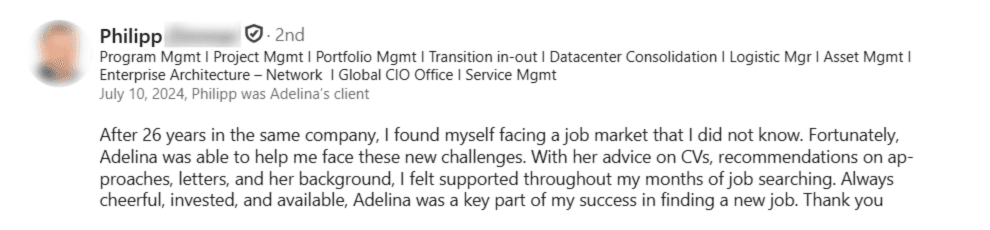
Philipp was able to secure a new role after repositioning his profile and focusing on the right conversations.
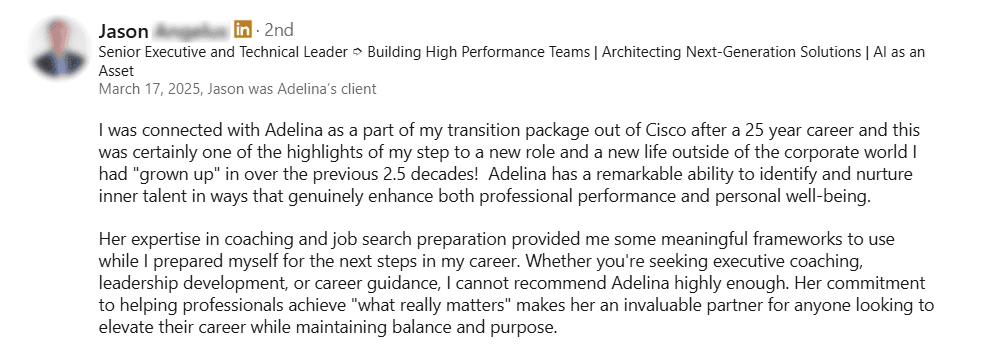
Jason chose a more flexible path. He joined a start up part time while exploring his own consulting direction, all while continuing to stay active in the job market.
Jeevan is another example. His approach focused mainly on networking, and he is now very close to securing a role that aligns with his experience.

Different paths, but one common thread.
They stopped relying on the system alone and started creating direct connections with the market.
The goal is not just to improve one part of the process.
It is to align your visibility, your network, and your documents so they work together and support the same message.
When this alignment is in place, the process becomes clearer and more effective.
You are no longer relying on one channel alone. You are creating multiple ways to be seen, understood, and considered.
If you feel that you have been doing everything right but still not getting the results you expect, it may be time to take a different approach.
Bypassing the Applicant Tracking System is only the first step. Once you get past the algorithm and into the hidden job market, you have to know how to communicate with the decision-makers. If you want to know exactly what to say (and what not to say) at the C-suite level, read my complete guide on how to master the covert language of Swiss executive hiring.
Frequently Asked Questions About the Executive Job Search in Switzerland

Why is my executive CV getting rejected by ATS?
In many cases, it is not about your experience but how it is presented. ATS systems look for clear matches in structure, keywords, and job titles. If your CV is not aligned with these expectations, it may not pass the first screening, even if you are qualified.
How do I network in Switzerland as a newly arrived expat?
Start by building visibility before asking for meetings. Follow decision makers, engage with their content, and show genuine interest in their work. Then, reach out with a thoughtful message focused on learning, not asking for a job.
How much of the Swiss job market is actually hidden?
A significant part of senior roles is never advertised. Many positions are filled through internal moves or referrals, which means online job boards only show a small portion of real opportunities, according to University of Zürich and research from Christian Gschwendt in 2022.
What does it mean when a Swiss employer says an executive is overqualified?
It often reflects concerns about fit, expectations, or long term alignment. Employers may worry about salary, stability, or whether the role will truly match your level of experience.
Is LinkedIn enough to find a senior job in Switzerland?
LinkedIn is a valuable tool, but it is not enough on its own. It works best when used to support real conversations, build relationships, and increase your visibility with the right people.
How long does a typical executive job search take in the Swiss market?
It often takes several months, sometimes longer. Senior hiring processes are slower, involve multiple stakeholders, and rely heavily on trust and alignment. For more details, check out this article: How Long Does it Really Take to Find a Job in Switzerland?
Can ATS recognize a career pivot or industry change?
Not easily. ATS systems tend to favor linear career paths and clear matches. If your profile shows a pivot, it needs to be clearly explained and supported with relevant keywords and results.
Do I still need a cover letter for executive roles in Switzerland
Yes, in most cases. A strong cover letter helps provide context, explain your motivation, and connect your experience to the specific needs of the role in a more personal way.